How to Prepare Land for Construction in Western North Carolina
Building on raw or undeveloped property starts long before concrete is poured or framing begins.
The land itself has to be cleared, shaped, stabilized, drained, and properly prepared to support whatever is being built on top of it.
That's particularly important in the mountains of Western North Carolina, where steep slopes, uneven terrain, heavy vegetation, drainage patterns, and changing soil conditions can make site development more complicated.
At Hazy River Earthworks, we help homeowners, builders, developers, and property owners prepare land through professional excavation services, land clearing and forestry mulching, grading and site preparation, driveway work, erosion control, and other earthwork services.
Here's what goes into taking an undeveloped piece of property and getting it ready for what's next.
Step 1: Evaluate the Property Before Moving Dirt
Good site preparation starts by understanding the land.
Every property presents different challenges. One site may be relatively level but covered in dense vegetation. Another may already be open but have steep slopes, poor access, drainage problems, or unstable areas.
Before major earthwork begins, important factors can include:
Existing terrain and slopes
Trees, brush, and vegetation
Access for equipment
Proposed building locations
Existing drainage patterns
Driveway location
Soil conditions
Utilities
Septic requirements
Areas susceptible to erosion
Understanding these conditions helps determine what work should happen first and how the different stages of the project need to work together.
This is especially important for excavation projects in Asheville, Leicester, and throughout Western North Carolina, where mountainous terrain can significantly affect how a property is developed.
Step 2: Land Clearing and Forestry Mulching
If you're starting with wooded or overgrown acreage, one of the first major steps may be clearing the property.
Professional land clearing and forestry mulching can remove unwanted brush, vegetation, small trees, and other growth to create usable space and provide equipment access.
But land clearing isn't simply about making everything disappear.
The goal should be to clear what's necessary for the project while considering the existing terrain and what needs to happen afterward.
Depending on the property, clearing may be performed to create space for:
A new home
Building sites
Driveways
Access roads
Septic systems
Utility routes
Pastures
Additional usable acreage
Future development
Once vegetation has been properly cleared, the actual shape of the land becomes much easier to evaluate.
Step 3: Excavation and Site Work
After the property is accessible, heavier earthwork can begin.
Professional excavation involves much more than digging holes. Excavation equipment can be used to cut into slopes, remove unsuitable material, establish elevations, prepare building areas, create drainage features, and reshape portions of the property.
This stage is where a raw piece of land begins turning into a functional construction site.
Good excavation work should also consider everything that comes later.
The driveway needs to connect properly to the building site. Water needs somewhere safe to travel. Utility routes need to make sense. Building areas need to be properly prepared.
Each part of the property should work together instead of being treated as an isolated project.
Step 4: Grading the Property
Grading is one of the most important stages of site preparation.
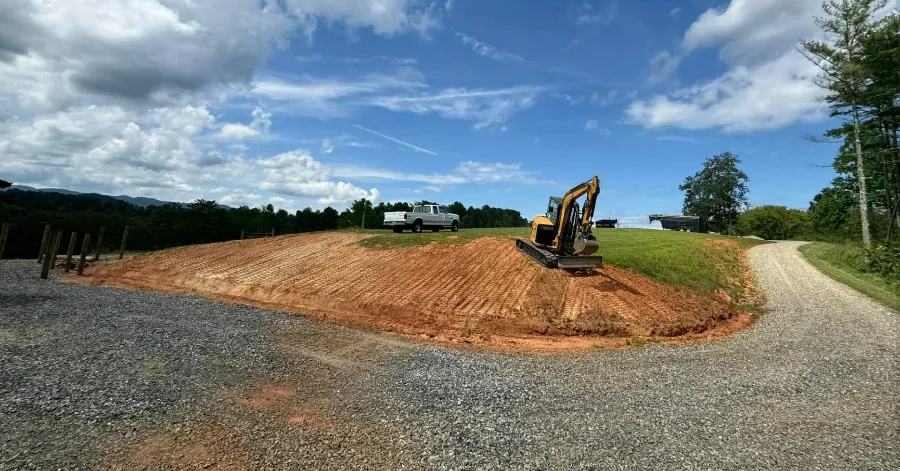
Professional grading and site preparation reshapes the ground to establish the elevations, slopes, drainage patterns, and stable surfaces required for construction.
This is particularly important in Western North Carolina.
Water naturally follows the terrain. If a property is graded incorrectly, runoff can travel toward structures, wash out driveways, create muddy areas, erode slopes, or cause other long-term problems.
Proper grading helps:
Establish stable building areas
Direct water away from structures
Improve property drainage
Create usable sections of land
Prepare driveways and access areas
Reduce erosion problems
Establish proper elevations
Prepare areas for landscaping or future development
This is why grading shouldn't be viewed as simply making dirt look smooth.
It's part of the foundation for everything that follows.
Step 5: Prepare the Building Pad
If the property is being developed for a home, garage, shop, or another structure, the building area needs special attention.
Professional building pad and foundation preparation creates the properly prepared area that will eventually support the structure.
Poor preparation underneath a building can contribute to settling, cracking, drainage problems, and expensive repairs later.
Building-pad preparation can involve removing unsuitable material, establishing proper elevations, placing appropriate material, compacting the area, and shaping the surrounding ground so water moves away from the future structure.
The work underneath the building may eventually disappear from view, but it's some of the most important work performed on the entire project.
Step 6: Plan the Driveway and Property Access
A building site isn't very useful if vehicles and equipment can't reliably reach it.
Driveway construction should be incorporated into the overall site plan rather than treated as an afterthought.
The route of a driveway can affect excavation requirements, drainage, slope, material quantities, accessibility, and long-term maintenance.
On mountainous properties, seemingly small changes to the driveway route can make a major difference.
Proper driveway installation can involve:
Clearing the route
Excavating unsuitable material
Establishing the correct grade
Creating proper drainage
Installing and compacting aggregate
Shaping the driving surface
Managing runoff along the driveway
Hazy River Earthworks provides driveway installation and repair as part of comprehensive property and site-development work.
Step 7: Address Drainage and Erosion Before They Become Problems
Water management should be considered throughout the entire project.
Western North Carolina receives substantial rainfall, and mountainous terrain can concentrate runoff quickly.
Once vegetation is removed and soil is disturbed, water can begin moving differently across the property.
Professional erosion control can help protect disturbed soil and manage vulnerable areas while the property is being developed.
The exact solution depends on the site, but the objective remains the same: control where water travels and protect the land from unnecessary erosion.
Ignoring drainage during site preparation can result in repairing the same areas repeatedly later.
Step 8: Utility Trenching and Underground Services
New construction also requires utilities.
Depending on the project, underground lines may need to be installed for water, electrical service, communications, drainage, or other systems.
Planning utility trenching and line installation alongside the rest of the site work can prevent unnecessary excavation later.
It can also help avoid situations where newly graded or finished sections of the property have to be disturbed again because underground infrastructure wasn't considered early enough.
Good site preparation is about sequencing.
Doing things in the right order can save time, reduce duplicated work, and create a cleaner overall project.
Step 9: Septic Excavation
Many properties throughout Western North Carolina aren't connected to municipal sewer systems.
For those properties, septic infrastructure becomes another major part of site development.
Professional septic services may require excavation and site work for system components while accounting for property layout, access, grading, and the surrounding terrain.
Like utility work, septic excavation should be coordinated with the broader site plan whenever possible.
What If There's an Existing Structure on the Property?
Not every development project begins with untouched land.
Sometimes an old house, garage, shed, concrete structure, or other improvement needs to be removed before the new project can begin.
Professional demolition services can clear the way for redevelopment and allow the property to be prepared for its next use.
Once demolition is complete, the site may require additional excavation, hauling, grading, and preparation before new construction can begin.
Material and debris removal can also be handled through professional hauling services, helping keep the site organized as work progresses.
Retaining Walls and Sloped Properties
Steep terrain is common throughout Western North Carolina.
In some situations, simply grading a slope isn't the best long-term solution.
A properly constructed retaining wall can help hold back soil, manage elevation changes, create more usable space, and support the overall layout of a property.
Retaining walls can become particularly important when creating building areas, driveways, parking areas, or usable sections of land on properties with significant elevation changes.
Like grading and drainage, retaining walls should be designed around how the entire property functions.
Why Site Preparation Matters So Much in Western North Carolina
Mountain property can be beautiful, but building on it requires understanding how the terrain behaves.
A flat property and a steep wooded lot shouldn't be prepared the same way.
Western North Carolina projects may have to account for:
Significant elevation changes
Dense vegetation
Mountain runoff
Steep driveway grades
Soil erosion
Limited equipment access
Drainage from surrounding slopes
Rock and difficult soil conditions
Existing creeks or drainage paths
That's why hiring an excavation contractor familiar with local terrain can make such a difference.
Hazy River Earthworks works throughout Western North Carolina, handling projects designed around the land instead of trying to force every property into the same solution.
Excavation and Site Preparation in Asheville, NC
For property owners planning construction or land improvements in Asheville, NC, professional site preparation can help turn difficult terrain into functional property.
From clearing and excavation to grading, driveways, drainage, and building-pad preparation, coordinating these services can create a smoother path from raw land to construction-ready ground.
Land Clearing and Grading in Leicester, NC
Based in Leicester, Hazy River Earthworks also provides excavation, grading, and land services in Leicester.
Properties throughout the area can range from open residential lots to wooded acreage and steep mountain terrain, making proper planning especially important before major construction or development begins.
Site Work in Hendersonville, NC
Property owners can also turn to Hazy River Earthworks for excavation and land services in Hendersonville.
Whether you're preparing residential property, improving access, clearing land, or developing a new building site, the condition of the ground determines how successful the next stage of the project can be.
Excavation Services in Waynesville, NC
Hazy River Earthworks provides excavation and grading services in Waynesville for properties requiring professional clearing, earthwork, site preparation, and related land improvements.
Mountain terrain makes proper grading and drainage especially important when preparing property for construction.
Land Development in Marion, NC
For property owners farther east, Hazy River Earthworks also provides excavation, grading, and land clearing in Marion, NC.
From preparing raw acreage to improving existing property, professional earthwork can help create stable, accessible, and usable land.
What Comes First: Clearing, Excavation, or Grading?
The exact order depends on the property.
Generally, access and necessary clearing happen before major excavation and grading, but every site is different.
For example, limited clearing may be required simply to get equipment onto the property. Excavation may then establish the main building area before grading begins. Drainage work, utilities, driveways, and final grading may happen at different stages as construction progresses.
That's why looking at the entire project before starting is so important.
Instead of asking only, "What needs to be dug?"
A better question is:
What does this property need to become?
Once that's understood, the clearing, excavation, grading, drainage, and site work can all support the same end goal.
Build From the Ground Up
Every successful construction project depends on what sits underneath it.
Clearing makes the land accessible.
Excavation begins shaping it.
Grading controls elevations and drainage.
Building-pad preparation creates a stable area for construction.
Driveway work provides access.
Utilities and septic infrastructure make the property functional.
Erosion control helps protect the work that's already been completed.
When these stages are planned together, raw property can be transformed into land that's ready for construction and long-term use.
Hazy River Earthworks provides professional excavation, land clearing, grading, and site preparation for homeowners, builders, developers, and property owners throughout Asheville, Leicester, Hendersonville, Waynesville, Marion, and surrounding Western North Carolina communities.
For more examples of projects completed in the field, take a look at our recent excavation, grading, and land clearing work.