
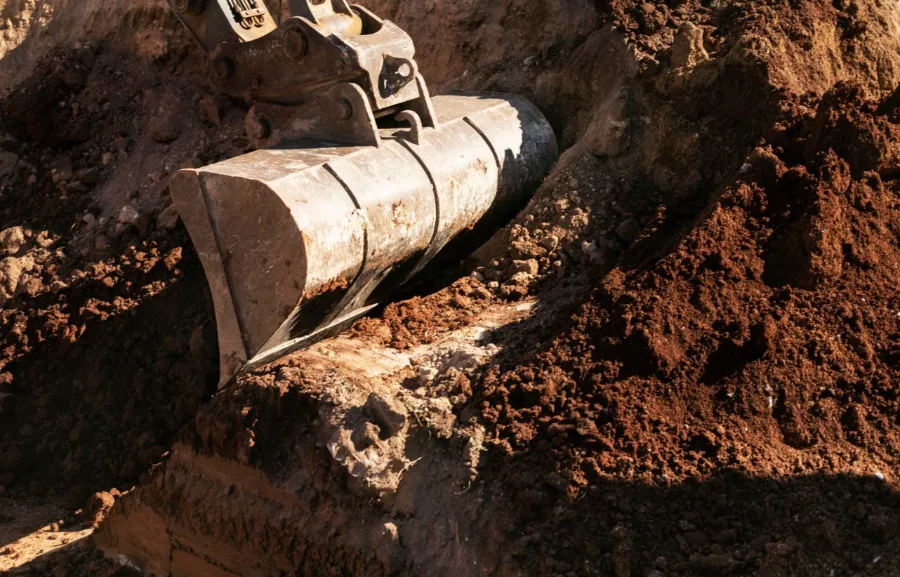
A driveway culvert is a pipe that carries ditch water under your drive, and in the mountains it is often the difference between a drive that lasts and one that washes out every storm. Its size depends on how much water reaches it, and where a drive meets a state road, the NCDOT District Engineer sets the size through a driveway permit.
When a drive needs a culvert
Any time water has to get from one side of your drive to the other, it needs a way under. The common spots are where the drive meets the road ditch, where it crosses a wet-weather branch, and at low points along the route where the uphill ditch fills.
On a steep or long drive in Western North Carolina, there is usually more than one of these. Without a pipe, ditch water either ponds against the drive and soaks the base, or it pours over the top and takes the stone with it. If your drive has a gully across it, or a soft spot that never dries, a missing or failed pipe is a likely cause.
Culvert pipe sizes
Pipe size comes down to how much water reaches it. A pipe draining a short ditch on a gentle lot can be small. One carrying runoff from a whole hillside, or a branch that runs hard after storms, needs a much bigger diameter. Too small, and it clogs with leaves and gravel and the water goes over the drive.
For entrances onto state roads, NCDOT's driveway access policy says the pipe must be large enough for the flow expected in the ditch, as determined by the District Engineer. It sets a minimum of 15 inches inside diameter unless the District Engineer directs otherwise, and a minimum length of 20 feet. On a private drive away from the road, the size is worked out on the ground by looking at the area uphill.
NCDOT permits for state road entrances
Most public roads in rural Western North Carolina are maintained by NCDOT. According to NCDOT's driveway permit FAQ, you must get a driveway permit to obtain or modify access to the State Highway System, and you apply through the local District Engineer's office. NCDOT does not charge to apply, though some services such as inspections can carry a charge.
In practice, that covers a new entrance and changes to an existing one. The permit also deals with drainage, which is where the entrance pipe comes in. Get it sorted before the entrance is cut. Pipe that carries an actual creek is a separate matter and can need its own permit, which we raise at the estimate.
How a driveway culvert should be set
A good culvert install is mostly about the parts you cannot see afterwards. The pipe needs a firm, even bed so it does not sag. It needs a steady fall toward the outlet so water and grit keep moving. And it needs enough compacted cover over it to spread the weight of trucks.
The ends matter too. The ditch should lead water straight into the inlet, not at an angle that undercuts the bank. The outlet needs rock so the water leaving the pipe does not carve a new gully down the hill. See our culvert and driveway pipe installation page for how we set pipe under drives and private roads.
What moves culvert installation cost
The pipe itself is only part of the price. Diameter and length set the material cost, and bigger pipe needs a deeper, wider trench and more cover. How deep it has to go, and whether the trench hits rock, changes the digging time.
Then there is the drive. A culvert set during a new build costs less than one cut into a finished drive that has to be rebuilt over it. Rock at the outlet, ditch work leading to the inlet and any permit work add to it. Access for the machine and trucks plays a part on steep lots. Ben walks the drive and prices it before work starts, and the estimate is free. For the drive itself, see gravel driveway cost.
After Helene: culverts that failed
The storm showed which pipes were too small. Many blocked with debris, overtopped and took the fill around them. Others were washed out entirely or left hanging where the bank eroded underneath.
Signs your pipe needs attention: water running over the drive in heavy rain, a sinking spot above the pipe, a crushed or buried inlet, or an outlet with a growing hole beneath it. A pipe that failed once at its old size will likely fail again, so replacing it is a good time to rethink the size. For water problems beyond the drive, see drainage solutions.
The short version
- A culvert carries ditch water under the drive so it cannot run over the top.
- Pipe size depends on how much water reaches it from uphill.
- NCDOT's policy sets a 15-inch minimum diameter and 20-foot minimum length for state road entrances, unless the District Engineer directs otherwise.
- A new or changed entrance onto a state road needs an NCDOT driveway permit from the District Engineer's office.
- Bedding, fall, compacted cover and a rock outlet decide how long a pipe lasts.
Quick answers
Quick answers
What size culvert do I need for my driveway?
Enough to carry the water that reaches it. At a state road entrance, NCDOT's District Engineer sets the size, with a 15-inch minimum unless directed otherwise. On a private drive, size it by looking at the ground draining to the pipe.
Does NCDOT install the driveway pipe?
It depends on the entrance and the permit. Ask the District Engineer's office when you apply. We can set the pipe and rebuild the drive over it once the permit terms are clear.
How deep should a driveway culvert be buried?
Deep enough to have firm, compacted cover that spreads the weight of vehicles, and set at a fall that keeps water moving. The right depth depends on the pipe type and the traffic.
Why does my driveway culvert keep clogging?
Usually the pipe is too small, set too flat, or the ditch feeds it at an angle that dumps gravel into the inlet. Fixing the fall, the size or the ditch usually ends it.
See our culvert & driveway pipe service or call (828) 900-1749.