
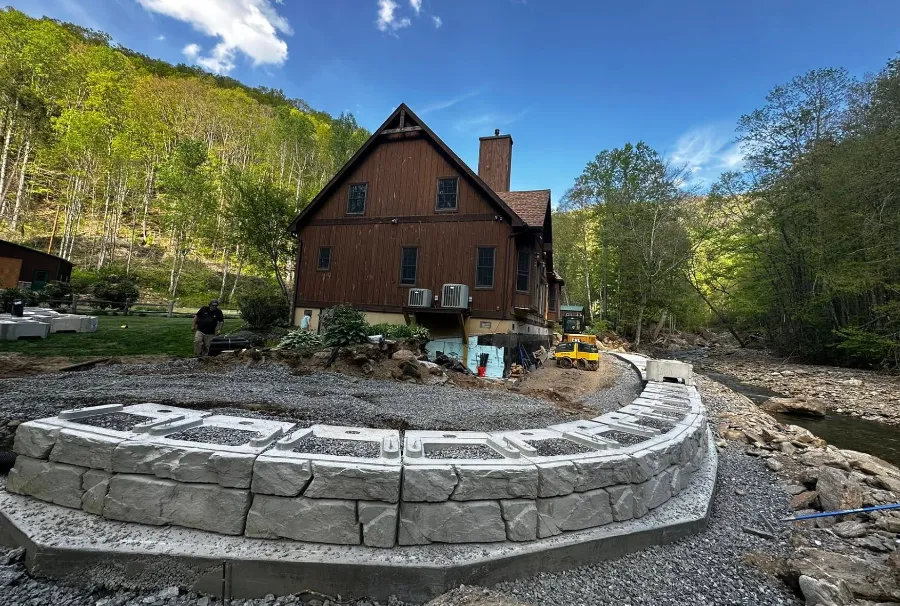
A retaining wall in Asheville costs whatever its height, length, base, drainage and site access demand, so two walls of the same length can be priced very differently. The only way to get a real number for your wall is a site visit, and Hazy River Earthworks gives that estimate free.
What you are really paying for
The blocks you see are only part of a wall. Most of the work sits below and behind the face. First the ground is dug out and a trench is cut for the base. That base is filled with stone, levelled and compacted. Then the first course goes down, followed by drain pipe, clean stone and fabric behind every course as the wall rises.
After the last course, the area behind the wall is backfilled and the ground around it is graded. A quote that looks low often leaves out part of that list. When you compare prices, ask each contractor what goes behind and under the wall, not just what goes on the face.
Retaining wall cost per foot, and why it misleads
People often search for a retaining wall cost per foot. The trouble is that a foot of wall is not a fixed thing. A two-course garden edge and a wall holding up a driveway can both be called one foot long.
What drives the work is the face area, meaning height times length, plus everything behind it. A taller wall needs a wider, deeper base, more stone behind it and more blocks per foot. Past a certain height it may also need an engineered design and county review. Our guide to the retaining wall permit in Buncombe County covers when that starts. So per-foot numbers from other regions rarely match a mountain lot.
Access, slope and soil on mountain lots
Around Asheville, the ground itself moves the price more than almost anything else. A machine that can drive straight to the wall line works fast. A wall behind a house, down a steep bank or at the end of a narrow drive takes longer to dig and longer to supply.
Soil matters too. Red clay holds water and needs good drainage behind the wall. Rock in the base trench has to be broken out or worked around. Wet ground after a run of rain can stop a dig for days. Ben looks at all of this on the walk and builds it into the price, so there are fewer surprises once the work starts.
Materials and the type of wall
Hazy River Earthworks builds block retaining walls, including large block that is too heavy to lift and is set by machine. Block size changes how fast a wall goes up and how much it can hold. Bigger units cost more each, but they can mean fewer courses and a stronger wall.
The stone behind the wall is a real material cost as well, along with drain pipe and fabric. Curves, steps and tiers add cutting and setting time. If you are still deciding on the kind of wall, our comparison of boulder, block and timber retaining walls lays out the trade-offs.
Haul-off, grading and timing
Digging a wall in means moving dirt. Some of it can be spread elsewhere on the property. On a tight lot it has to be loaded and hauled away, and that trucking is part of the price. The same goes for old walls, roots and rock that come out during the dig.
Most walls are also part of a bigger job: a pad, a levelled yard or a drive that needs holding. When the same crew does the grading and site prep around the wall, it is planned once and priced once. Season plays a part too. Wet winter and spring weeks slow clay work, so a flexible start date can help.
How to get a useful estimate
Send a few photos of the slope, a rough length and height, and what the wall needs to hold back. Say whether a truck can reach the spot. That lets Ben arrive with the right questions.
On site he walks the wall line with you, checks where the water comes from, and looks at access and soil. If the wall looks tall enough to need an engineer, he will say so at that point. You get a price before anything starts. Call (828) 900-1749 or use the form on the retaining walls page to set up a free visit.
The short version
- Height, length, base depth, drainage and access set the price more than the blocks do.
- Per-foot prices hide the work behind and below the wall.
- Steep access, clay, rock and haul-off are the usual cost drivers around Asheville.
- Tall walls can need an engineered design and county review, which adds time and cost.
- A free site visit from Hazy River Earthworks gives you a real price before work starts.
Quick answers
Quick answers
How much should I expect to pay for a retaining wall?
It depends on the wall's height and length, the base and drainage it needs, how easy the spot is to reach and how much dirt has to be hauled. A low wall in an open yard and a tall wall below a house are very different jobs. A free estimate is the only honest way to get a number.
Is a retaining wall priced by the foot?
Some contractors quote that way, but the real cost follows the face area and the work behind it. A taller foot of wall needs a deeper base, more stone and more block than a short one.
What type of contractor builds retaining walls?
Landscapers, hardscape companies and excavation contractors all build them. An excavation crew brings the machines to dig the base, set heavy block and grade the ground around the wall in one job.
Can I bring the cost of a retaining wall down?
Sometimes. A shorter wall with a graded slope above it, a straight run instead of curves, or reusing dug soil on site can all help. Ben can talk through options like these at the estimate.
See our retaining walls service or call (828) 900-1749.