
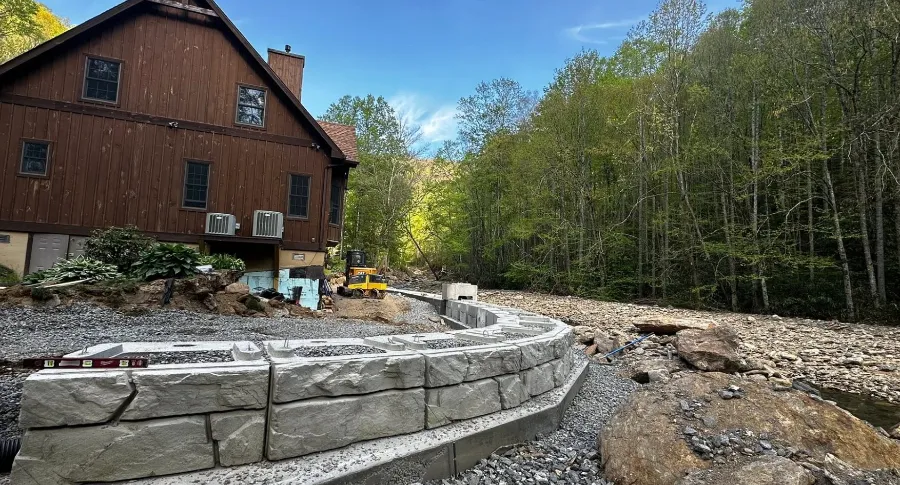
In Buncombe County, a wall system with more than 10 feet of cumulative height falls under the county retaining wall ordinance and needs a certificate of compliance from Planning, a building permit and an engineer's sign-off. Shorter walls can still need a building permit or an engineered design depending on height, location and what they hold up, so check with the county before you build.
Who handles retaining wall permits
For most properties outside a city or town, the office is Buncombe County Planning and Development at 35 Woodfin Street in Asheville. Its main line is 828-250-4830. The county's Permits and Inspections Department issues building permits, and Planning handles zoning and the retaining wall ordinance.
Inside Asheville city limits, the City of Asheville runs its own development process. Other incorporated towns can handle zoning inside their own limits, so ask your town hall too. If you are not sure whose rules cover your lot, the county Planning line can point you to the right desk. Then call that office before the first block goes in.
The county ordinance for tall wall systems
Buncombe County has a retaining wall ordinance, first adopted in June 2011. Its published text covers wall systems with more than 10 feet of cumulative vertical relief. That is measured from the lowest point of the wall system after grading to the highest point, so stacked or tiered walls are added together.
For walls in that range, the ordinance calls for a certificate of compliance from Planning before the wall is built, then a building permit from Permits and Inspections. Once it is finished, the design engineer certifies that the wall was built to the approved plan, including base, soil, backfill and drainage. Systems over 20 feet must be terraced. Rules change, so confirm the current version with Planning.
Retaining wall permit rules for shorter walls
Walls under the ordinance's 10 foot line are not automatically free of rules. The North Carolina residential building code sets a height above which a retaining wall needs an engineered design, and that threshold has been revised over the years. Walls that hold up a drive, a building or another wall, or that sit near a property line, can be treated differently from a simple yard wall.
Because of that, we will not quote a single height that applies to every lot. Call Buncombe County Permits and Inspections, or your town if you are inside one, with the wall height, its location and what it supports. They can tell you whether a permit or an engineer is needed for your wall.
When the grading needs its own permit
Building a wall often means cutting and filling ground around it. That digging is land disturbance, and it has its own rules. Buncombe County requires an erosion control permit for land-disturbing activity of one acre or more, and a quarter acre or more in a hillside subdivision.
A single wall rarely reaches those sizes alone. It can when the wall is part of a new homesite with a drive, a pad and utility lines. Below the threshold, silt fence and other protective measures are still expected. Our guide to the land disturbance permit in Buncombe County explains how that process works.
Walls near creeks and on steep ground
A wall along a creek brings in more agencies. Buncombe County notes that work inside a stream needs a permit from the US Army Corps of Engineers. North Carolina also requires an undisturbed buffer at least 25 feet wide, measured from the top of the bank, along trout waters during land-disturbing work, and many mountain streams carry that classification.
On steep lots, the county's erosion control reviewers look at slope steepness and at streams and springs on the site. If your wall is meant to hold a creek bank, our guide on how to stop creek bank erosion covers the options and the permits to ask about.
How we handle the permit question on a wall job
At the free estimate, Ben looks at the height, what the wall is holding and how close it sits to property lines, buildings and water. If the wall looks like one that needs an engineered design or county review, he tells you then, before you have spent anything.
Who pulls the permit is agreed with you before work begins. Then the wall is built on a compacted base with drain pipe, clean stone and fabric behind it, as on every block retaining wall we put in. Call (828) 900-1749 to set up a visit.
The short version
- Buncombe County's retaining wall ordinance covers wall systems over 10 feet of cumulative height.
- Those walls need a certificate of compliance, a building permit and an engineer's certification.
- Shorter walls can still need a permit or engineered design under the state building code.
- Asheville and other towns run their own permit offices inside their limits.
- Work in a stream needs an Army Corps permit, and trout waters carry a 25 foot buffer.
Quick answers
Quick answers
Do I need a permit to build a retaining wall in Buncombe County?
Wall systems over 10 feet of cumulative height fall under the county ordinance and need county approval. Shorter walls may still need a building permit depending on height and what they hold up, so call Buncombe County Permits and Inspections with your wall's details.
When does a retaining wall need an engineer?
Tall walls, and walls supporting a building, a drive or another wall, often need an engineered design. In Buncombe County, systems over 10 feet need an engineer to certify the finished wall. Ben will tell you at the estimate if yours looks like it needs one.
Does a tiered retaining wall count as one wall?
For the county ordinance, height is measured as cumulative vertical relief, from the lowest point of the wall system after grading to the highest. Tiers can add up to one regulated system.
Who do I call about a retaining wall inside Asheville city limits?
The City of Asheville handles permits inside its limits. Outside the city and towns, call Buncombe County Planning and Development at 828-250-4830.
See our retaining walls service or call (828) 900-1749.