
Under the North Carolina plumbing code, as explained by the NC Office of State Fire Marshal, the top of a buried water service pipe must sit at least 12 inches below grade or below the frost line, whichever is deeper. In the mountains, confirm the frost depth for your address with the local building inspections office before you trench.
The rule in plain words
The depth is measured to the top of the pipe, not the bottom of the trench. With a 12 inch minimum, the trench has to be deeper than that by the pipe size and the bedding underneath.
Where the local frost line is deeper than 12 inches, the frost line wins. The same state guidance says insulation cannot be used to reduce the depth, because buried insulation breaks down and stops protecting the pipe. Codes are revised over time, and section numbers move between editions. Check the current edition with your county or town inspections office before you dig, especially if the job is under a permit.
Frost depth in the mountains
Western North Carolina covers a wide spread of elevations. A valley lot near the French Broad River and a ridge top at the county line can have very different winters. That is why the local building inspections office, not a national map, is the place to confirm frost depth for your address.
Exposed spots need extra thought. A line that comes up at a yard hydrant, passes near a culvert or runs under a drive where snow is plowed off can freeze where the rest of the line does not. Going deeper than the minimum costs some extra digging and buys real protection on a cold north slope.
Rock, clay and slope
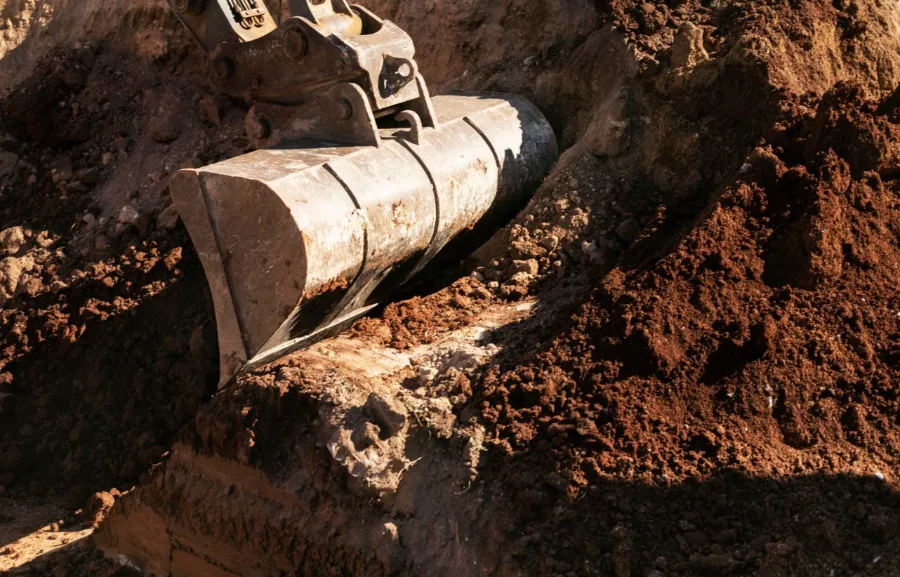
Mountain trenching rarely matches the plan on paper. Rock near the surface can stop the bucket short of the depth the line needs. Red clay is heavy, holds water and can cave in when it is wet. Steep ground makes it hard to hold an even depth over the whole run.
When rock blocks the depth, the options are breaking it out, rerouting the line or asking the inspector what is acceptable. Laying pipe shallow and hoping is not one of them. Our utility trenching is dug to the depth the line needs, with the bottom bedded before the pipe goes in.
Bedding, backfill and protection
How the line is buried matters as much as how deep. The trench bottom should be smooth, with no sharp rock that can press into the pipe. Bedding goes under the pipe, and clean material goes around it.
Backfill goes back in layers that are compacted, so the trench does not sink later and turn into a ditch that carries water. Where the line crosses under a driveway, ask about running it through a sleeve so it can be replaced later without tearing up the drive. Tracer wire or warning tape over plastic pipe helps the next person find it. Ask your plumber or inspector what your job calls for.
Call 811 and keep clear of other lines
Public utilities are located through NC 811 before any digging, as state law requires. Private lines are a different matter. Power to an outbuilding, an old water line, irrigation and septic lines are usually yours to point out.
Water lines also need distance from septic tanks, drain fields and sewer lines. The county environmental health office sets well and septic setbacks, and the plumbing code covers separation from sewer pipe. Ask before you lay out the route, so the trench does not have to move after the inspector sees it. A short call early saves a second trench later.
Who does what on a water line job
The trench and the plumbing are often separate trades. A plumber makes the connections at the meter, the well and the house, and any inspection is arranged through the permit.
Our part is the dirt: digging the trench to depth on rocky ground, bedding it, and backfilling and compacting once the line is in and inspected. Coordinating the two saves trips. If you are also building a drive, a pad or a septic system, the trench can be planned with that work so nothing is dug twice. See our excavation work, or the septic installation cost guide if a new system is part of the plan. Call (828) 900-1749 for a free estimate.
The short version
- NC plumbing code: top of the water pipe at least 12 inches below grade or below the frost line, whichever is deeper.
- Insulation does not count toward the depth.
- Confirm frost depth for your address with the local inspections office.
- Call NC 811 before digging and point out private lines yourself.
- Bed the pipe, keep rock off it and backfill in compacted layers.
Quick answers
Quick answers
How deep does a water line need to be buried in NC?
The NC Office of State Fire Marshal explains the plumbing code rule as the top of the pipe at least 12 inches below grade or below the frost line, whichever is greater. Check the current code edition with your local inspections office.
What is the frost line in Western North Carolina?
It varies with elevation and exposure, so ask the building inspections office for your county or town. They can tell you what depth they expect for footings and buried water lines at your address.
Can I use insulation instead of burying the line deeper?
No. State code guidance says insulation cannot be used to reduce the required depth, because buried insulation breaks down and stops protecting the pipe.
What if I hit rock before reaching the depth?
Break it out, reroute the line or ask the inspector what is acceptable. A shallow line is the one most likely to freeze or be damaged later.
See our utility trenching service or call (828) 900-1749.