
In Western North Carolina, a perc test is really a soil and site evaluation done by the county environmental health office, or by a private evaluator under state options, before a septic permit is issued. The evaluator checks slope, soil texture, wetness and depth to rock, and the result decides whether, where and what kind of septic system the lot can have.
What a perc test means in North Carolina
Most people call it a perc test. The county calls it a soil and site evaluation. Rather than timing water as it drains from a hole, the specialist bores into the ground with an auger and reads the soil itself.
The state permit review worksheet lists what gets recorded. That includes topography and landscape position, slope, soil texture and structure, signs of soil wetness, depth to rock or other restrictive layers, and whether there is enough usable space. On mountain land those answers can change within a few hundred feet. A ridge shoulder may pass while the cove below it fails. So the evaluation looks at the spot where the house and drain field are planned, not the parcel in general.
Who does the perc test in Buncombe County
In Buncombe County, septic and well applications go to the Environmental Health Services Division at the Permitting Center, 35 Woodfin Street in Asheville. The application needs the property PIN and a plat or scaled map, and the fee is paid when you apply. The county asks you to call the permitting office first so staff can tell you what to bring.
State law also allows the evaluation to be done by a professional engineer, soil scientist or geologist under the engineered option, or by an Authorized On-Site Wastewater Evaluator. Madison, Henderson, Haywood and McDowell land goes through the health department for that county, with its own forms and fees. Call the office for the county your land sits in before you book anything.
How to get the lot ready for the evaluation
Buncombe's instructions are specific. Property corners and lines must be clearly marked, and the county recommends flagging about every 50 feet. Every proposed structure gets staked out, including the house, porches, decks, garage and driveway. Wells, springs and surface water on the land or within 50 feet of it need to be located.
Undergrowth has to be cleared so the specialist can see at least 50 feet from any one spot. The county will not schedule the visit until you call to say the site is ready, and a revisit fee can apply if it is not. On a grown over mountain lot, that clearing is often the hardest part. Brush clearing opens the ground up without disturbing the soil underneath.
Do not grade before the permit
The Buncombe application includes a statement the owner signs: no grading is to be done before the permit is issued. Take that seriously. Cutting a pad or pushing dirt around can strip or bury the soil the specialist needs to read. A site that would have passed can end up failing.
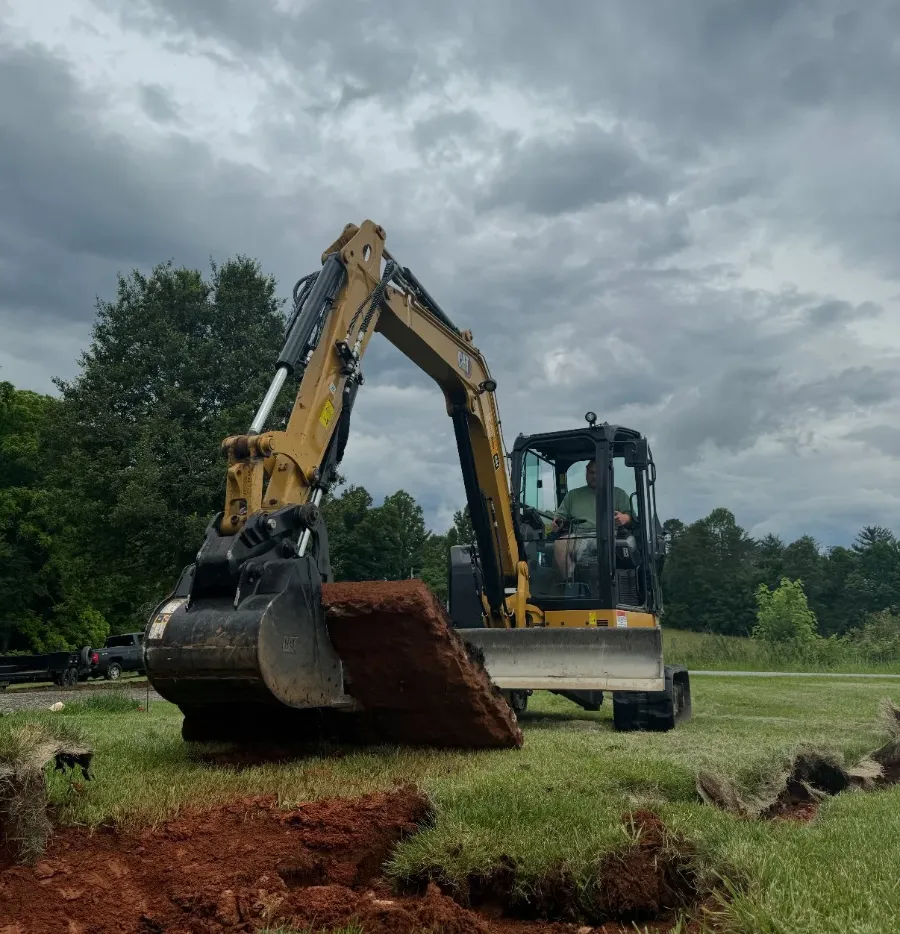
Cutting brush so the specialist can see is one thing. Moving soil is another. If you plan to clear, lay out a drive or cut a house site, talk to the county first, get the evaluation, and only then grade to the plan. On new homesites our crew works in that order so the permitted area stays intact and the system can go where it was approved.
What moves the cost of a perc test
The evaluation fee is set by the county and printed on its fee schedule, so call the office for the current amount. What changes your total is everything around it.
A lot with marked corners, open sight lines and an easy way in costs little to prepare. A wooded slope with no visible lines may need a surveyor and some clearing before the visit. A private evaluator under the state options is priced differently than the county route. And if the first area does not work, a second spot may need to be opened up and looked at. Grown over access, steep ground and thick briars all add machine time. We give no figures here because the county sets its fee and every lot is different.
If the land fails, and what follows a pass
A lot that cannot be permitted is turned down in writing. That is not always the end. Another spot on the parcel may work, a different system type may be possible, or a private evaluator may reach another finding under the state options. Ask the county what the denial was based on before you decide anything.
If the land passes, the health department issues an improvement permit and an authorization to construct. Under state law, an improvement permit tied to a site plan is valid for five years, and one tied to a plat does not expire. From there the septic installation is dug to that approved layout. For what drives that price, read the septic installation cost guide.
The short version
- In North Carolina a perc test is a soil and site evaluation, read from auger borings.
- Buncombe County applications go to Environmental Health at 35 Woodfin Street in Asheville.
- Mark lines, stake every structure and clear undergrowth before the visit is booked.
- Do not grade before the septic permit is issued.
- A permit tied to a site plan lasts five years; one tied to a plat does not expire.
Quick answers
Quick answers
How much does a perc test cost in NC?
The county sets the evaluation fee on its fee schedule, so call your county environmental health office for the current amount. The other costs are site prep: marking lines, clearing undergrowth and staking the house and drive. A private evaluator is priced separately.
Who does perc tests in North Carolina?
The county health department's environmental health specialists do most of them. State law also lets a professional engineer, soil scientist or geologist, or an Authorized On-Site Wastewater Evaluator, do the evaluation under separate options.
How long is a perc test good for in NC?
The result is issued as an improvement permit. Under state law, a permit tied to a site plan is valid for five years, and a permit tied to a plat is valid without expiration. Confirm the details of your permit with the county.
What happens if my land fails a perc test?
You get a written turn down. Ask what it was based on. Another area of the lot, a different system type or a private evaluation may still lead to a permit, so talk to the county before giving up on the land.
See our septic installation service or call (828) 900-1749.