
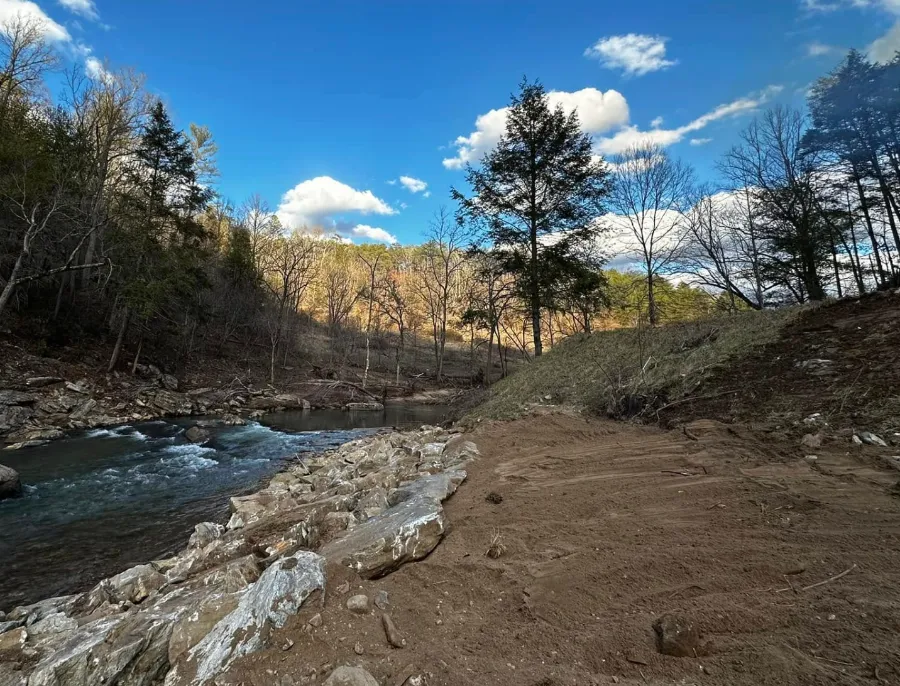
To stop a creek bank from eroding, protect the toe where the water cuts, lay the bank back to a slope that can hold, and armor or plant it so the next flood cannot pull it apart. On mountain creeks after a storm like Helene, that usually means rebuilding the bank with rock and fixing the runoff above it, and work in the stream can need a permit first.
Why creek banks fail
Most bank failures start at the bottom. Fast water digs at the toe of the bank, especially on the outside of a bend where the current hits hardest. Once the toe is undercut, the soil above has nothing to rest on and drops into the creek.
Other things speed it up. A fallen tree or debris jam can push the flow sideways into a bank that was stable for years. Banks stripped of roots wash faster. Runoff from a yard, a drive or a pipe pouring over the top cuts gullies from above. After a big flood, the channel can shift, leaving banks exposed in places that never saw strong current before.
Stream bank stabilization methods
There are a few proven ways to hold a bank, and most repairs combine them. Rock at the toe takes the force of the water where it cuts. Laying the bank back to a gentler slope means less weight is pressing down on an undercut edge.
Above that, the face needs armor, roots or both. Placed rock, often called riprap, protects banks that take direct current. Deep-rooted native plants and grass can hold upper banks that only see high water now and then. Our guide to riprap for creek banks explains how rock armor is sized and placed so it stays put.
Mistakes that make bank erosion worse
Dumping concrete chunks, old block or loose dirt over the edge rarely holds. The creek pulls it apart in the next storm, and it can choke the channel downstream. Pushing soil into the creek to rebuild a lost yard narrows the channel and speeds up the water.
Hard fixes can also move the problem. A wall or rock pile that sticks out into the current can throw water at the opposite bank or the neighbor downstream. Cutting every tree and shrub off a bank removes the roots that were holding it. The aim is to work with the creek's path, not fight it.
Fix the water coming from above
Sometimes the creek is not the main problem. Water running off a drive, a roof or a steep yard can cut down through the top of the bank and keep washing the same spot no matter how much rock sits at the bottom.
Catch that water before it reaches the edge. A swale that turns runoff to a lined outlet, a culvert outlet armored with rock, or a drive regraded to shed elsewhere can take a lot of stress off the bank. That is part of our wider erosion control work, and it is often priced alongside the bank repair.
Permits before you work in the creek
Work in or along a creek is regulated. Buncombe County's erosion control FAQ states that work inside a stream needs a US Army Corps of Engineers permit. State rules also require an undisturbed buffer at least 25 feet wide from the top of the bank along trout waters during land-disturbing work, and many mountain creeks carry that classification.
Rules vary with the size of the job and the stream. Before any machine goes in, call the Corps and your county erosion control office, or raise it at the estimate. Our guide to the land disturbance permit covers the county side.
How we rebuild a creek bank
Bank work starts with a free site visit. Ben walks the creek with you to see where the current is cutting and what sits behind the bank: a yard, a drive, a house or a private road. Permits are talked through before work is scheduled.
On the job, fallen trees and flood debris come out first and are hauled off. The bank is then shaped and rebuilt with rock, and the ground behind it is regraded so runoff no longer pours over the edge. See our creek and river bank repair page for photos of that work, or call (828) 900-1749.
The short version
- Banks usually fail at the toe, where fast water undercuts them.
- Protect the toe, lay the bank back and armor or plant the face.
- Loose fill and concrete rubble over the edge rarely hold.
- Runoff from above can wash a bank as badly as the creek does.
- Work inside a stream needs an Army Corps permit, and trout waters carry a 25 foot buffer.
Quick answers
Quick answers
What is the fastest way to stop a creek bank from washing away?
Protect the toe of the bank where the water is cutting, usually with properly placed rock, and stop any runoff pouring over the top. Check permit needs before working in the stream.
Who is responsible for creek bank erosion on my property?
In most cases the landowner looks after the banks on their own land. Rules on what you can do in the stream still apply, so talk to your county erosion control office and the Army Corps of Engineers before starting work.
Can I put rocks on my creek bank myself?
Small hand-placed stone rarely survives a mountain flood, and work inside the stream can need a permit. Rock sized for the flow and keyed into the creek bed holds far better.
How soon after a flood should a damaged bank be repaired?
Before the next heavy rain if you can. An undercut bank keeps losing ground with every high water, and the repair usually grows with it.
See our creek & river bank repair service or call (828) 900-1749.