
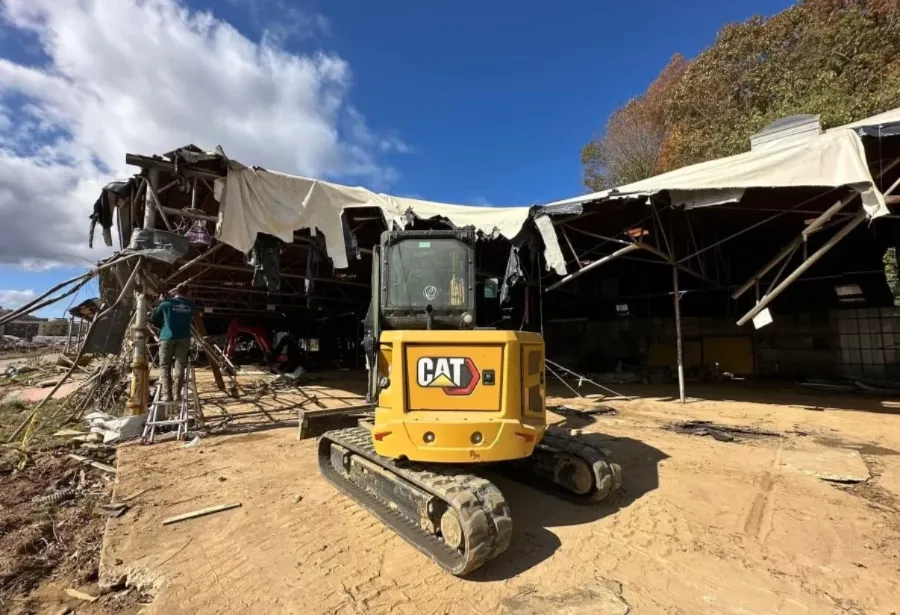
Mobile home demolition in North Carolina means tearing down the old home, loading and hauling the debris, pulling the piers, skirting and porches, and leaving the lot cleared for what comes next. Before work starts, the utilities must be disconnected, the local permit checked and the state asbestos rules confirmed with the right office.
When tearing it down makes sense
Old mobile homes on Western North Carolina land often reach the point where repairs cost more than the home is worth. Roofs leak, floors go soft, and a bad storm finishes the job. Helene left plenty of them beyond use.
Some owners want the space for a new home. Others want the land cleared to sell, garden or park a camper. A home that is still sound may be moved by a hauler. A home too far gone to roll is torn down where it sits, loaded out and the site cleaned up. That second job is what this guide covers.
Paperwork before the machine starts
Start with the permit office for your county or town and ask whether a demolition permit is needed for the home. Then the utilities. Power, water and any gas or propane have to be disconnected by the providers before anything comes down.
North Carolina requires buildings to be inspected by an accredited asbestos professional before demolition, and the state Health Hazards Control Unit to be notified. Ask the HHCU at 919-707-5950 how those rules apply to a mobile home, since older homes can contain asbestos in flooring, siding or roofing. Settling this early keeps the schedule clean and avoids a stop halfway through.
What the teardown covers
Most of the work is in the details around the home. Skirting, porches, steps, decks and carports come off first. The home is pulled down by machine, loaded and hauled.
Then the piers, blocks, tie downs and anchors are removed so the ground underneath is clear. Old sheds, burn barrels and junk around the lot are often part of the same cleanup. Metal from the frame and roof can be kept separate. Debris goes to a facility that accepts it, not into a hole on the property. When the crew leaves, the ground is clear and ready for the next step.
The septic, well and lines left behind
A mobile home lot usually has a septic tank, a well or water line, a power pole and sometimes a propane tank. Decide what happens to each before demolition day.
If a new home will use the existing septic, ask the county environmental health office whether the old permit still covers it before you plan around it. Keep machines off the drain field during the teardown so the lines are not crushed. If the septic or well will not be used again, ask the county how it should be closed. Point out everything you know about at the estimate, so nothing gets hit.
What moves the price
The size of the home, and whether it is a single or double wide. Add ons like porches, extra rooms and carports. What the home is built from and how much debris it makes. Access, slope and how close a truck can get. How much junk and outbuilding debris comes with it. Haul distance to a facility that takes the material. How finished the site needs to be: cleared only, or graded for a new pad.
Any asbestos abatement is a separate cost done before the teardown. We list no figures here. A free estimate after Ben walks the lot is the number to rely on. The house demolition cost guide covers the same factors in more depth.
Getting the lot ready for a new home
Once the old home is gone, the ground usually needs work. Pier holes get filled. Ruts get graded out. If a new home is going in, the pad may need cutting, filling and compacting, and the drive may need rebuilding after years of wear.
Water should run away from the new home site, not toward it. That is grading and site prep, done by the same crew that handled the teardown, so machines come out once. See our demolition page, then call (828) 900-1749 or send the form for a free estimate.
The short version
- A home too damaged to move is torn down on site, loaded and hauled.
- Check the local permit, disconnect utilities and confirm asbestos rules with the HHCU first.
- Piers, skirting, porches and anchors all come out so the ground is clear.
- Protect the drain field during demolition if the septic may be reused.
- Grading after removal gets the lot ready for a new home.
Quick answers
Quick answers
How do you get rid of an old mobile home in NC?
If it can still be moved, a hauler may take it. If not, it is torn down on site, the debris is loaded and hauled to a facility that accepts it, and the piers and anchors are removed. Check permits and asbestos rules first.
Do I need a permit to demolish a mobile home?
Ask the permit office for your county or town, since requirements vary. Separately, the state Health Hazards Control Unit can tell you how its asbestos inspection and notice rules apply to your home.
Can I reuse the septic system after removing a mobile home?
Sometimes. Ask your county environmental health office whether the existing permit covers a new home before you plan on it, and keep machines off the drain field during demolition.
What happens to the ground after the home is gone?
The piers, blocks and anchors come out and the site is cleared. If you want, the ground can then be graded, a pad built and the drive rebuilt so the lot is ready for a new home.
See our demolition service or call (828) 900-1749.