
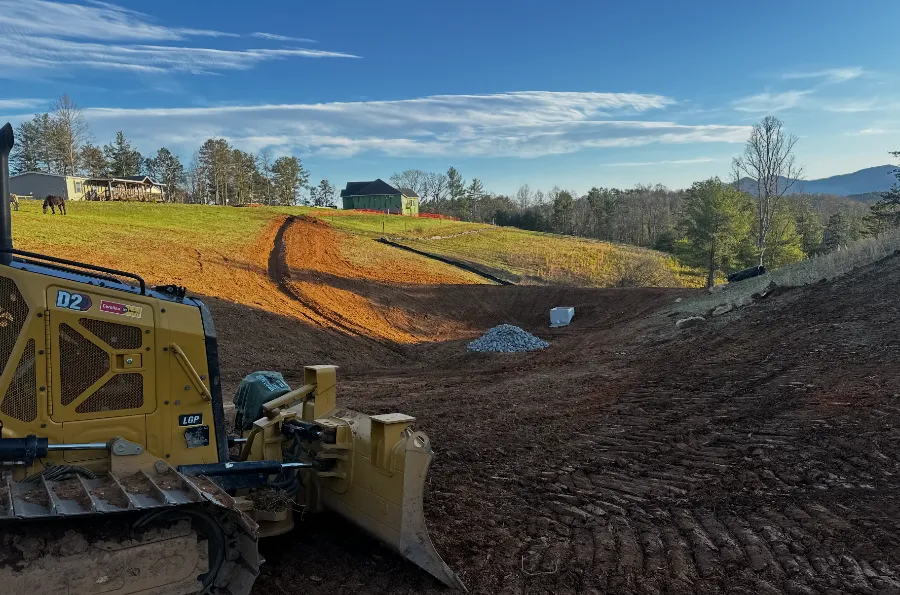
Grading cost in Western North Carolina depends on how much soil has to move, how steep the ground is, what the soil is made of, how much fill comes in or spoil goes out, access, drainage and erosion control. A price per acre rarely fits a mountain site, so the dependable number comes from a free estimate after someone walks the ground.
How much dirt moves
The core of any grading price is volume. A yard that needs reshaping to stop water ponding is light work. A house pad cut into a hillside moves a lot of material, and every load has to go somewhere.
The tidiest jobs balance cut and fill on site, so dirt taken from the high side builds up the low side. When they do not balance, fill has to be trucked in or spoil hauled away. That trucking can cost as much as the machine work. A clear site plan, even a rough one, helps keep the number honest because everyone is pricing the same shape of ground.
Slope and the shape of the lot
Steep ground is slower. Machines have to work the slope with care, cuts have to be shaped so they hold, and fill has to go down in layers and be compacted so it does not slide.
A gentle lot with room to stockpile dirt is quick. A narrow lot on a hillside with nowhere to set material means moving it twice. Tall cuts may need a retaining wall or rock to hold them, which is its own cost. Looking at the slope in person is the only fair way to price it, which is why grading is priced on site, not from a map.
Soil, clay and rock
Ground in Western North Carolina is often red clay with rock below it. Clay compacts well at the right moisture and turns slick when it is wet, so rain can stop a job or change how it is done.
Topsoil is stripped and stockpiled before grading so it can be spread back at the end. That costs time, but it saves buying topsoil later. Rock is the unknown. A cut that hits rock slows down and may need a different approach or a change in the plan. When rock or anything else unexpected turns up, you hear about it before the work or the price changes.
Rough grade, final grade and drainage
Rough grading sets the shape and the fall of the ground. Final grading is the finishing pass that leaves it ready for seed, sod, stone or concrete. Some jobs need only one of the two.
Drainage is the reason most grading is done, so swales, ditches, pipe and culverts may be part of the price. A building pad also needs compaction and often a stone finish. Say what the ground is for at the estimate. A level yard, a pad for a shop and a new driveway each need a different amount of finishing on the same lot.
Permits and erosion control
In Buncombe County, an erosion control permit is required for land disturbing activity of one acre or more. On property in a Hillside Subdivision under the county subdivision ordinance, the trigger is a quarter acre. Every disturbance, whatever its size, still needs protective measures like silt fence.
The county division does not enforce inside the City of Asheville, which has its own rules, and other counties have their own offices. Silt fence, seed, straw and stone all cost money and belong in the estimate. See the land disturbance permit guide and our erosion control page.
Access, season and how to lower the price
How equipment reaches the site matters. A tight entrance, a weak crossing or a washed out drive may need work before grading can start. Season counts as well. Long wet stretches slow clay work, and bare ground in storm season needs cover fast.
To bring the price down, settle the plan before the estimate, balance cut and fill where you can, keep topsoil on site and have clearing, grading and the drive done by one crew. Ben will walk the lot and give you a price before work starts. See grading and site prep or call (828) 900-1749 for a free estimate.
The short version
- Volume of dirt moved and where it goes drive most grading prices.
- Steep slopes, wet clay and rock all slow the work.
- Balancing cut and fill on site cuts trucking costs.
- Buncombe County requires an erosion control permit at one acre, or a quarter acre in a Hillside Subdivision.
- Erosion control and drainage belong in the estimate, not as an afterthought.
Quick answers
Quick answers
How much does it cost to grade land in Western NC?
It depends on how much soil moves, slope, clay and rock, fill or haul off, drainage, erosion control and access. No flat figure fits all of that, so the estimate is free and done on the ground.
Is grading priced per acre?
Rarely, and a per acre number misleads on mountain land. One acre can be a gentle yard and the next a hillside pad with rock. The work involved matters more than the acreage.
Do I need a permit to grade my lot in Buncombe County?
Buncombe County requires an erosion control permit for one acre or more of disturbance, or a quarter acre or more in a Hillside Subdivision. Smaller jobs still need silt fence or similar protection. Inside Asheville city limits, check with the city.
What is the difference between rough and final grading?
Rough grading sets the overall shape and fall of the ground. Final grading is the finish pass that leaves it ready for seed, sod, stone or concrete.
See our grading & site prep service or call (828) 900-1749.