
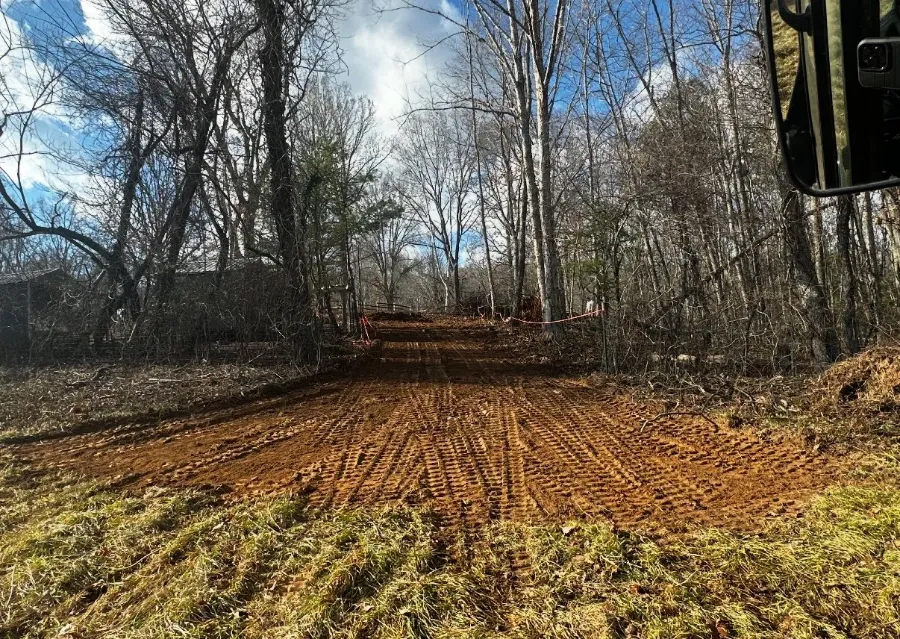
Forestry mulching grinds brush, briars and small trees where they stand and leaves the mulch on the ground, while land clearing removes trees, stumps and root balls so the ground can be graded and built on. Mulching suits views, trails, fence lines and overgrown lots, and full clearing suits house sites, pads and drives.
What is forestry mulching
A forestry mulcher is a machine with a spinning head that chews standing brush and small trees into chips. The growth is ground in place and spread over the surface as a mat. Nothing is piled, burned or hauled.
The roots stay in the soil and keep holding it. On a mountain slope that matters, because bare dirt is what washes away in the first heavy rain. The result is open, walkable ground with a layer of mulch that breaks down over time. Our forestry mulching page shows the kind of ground it suits around Asheville and the rest of Western North Carolina.
What land clearing does differently
Land clearing takes things out of the ground. Trees are cut, stumps and root balls are pulled, and the material is mulched, hauled or both. The ground is left ready for grading, a pad, a drive or a septic field.
That is the difference that counts. Mulching leaves a surface. Clearing leaves a site. A house should not sit on a mulch mat over old roots, because roots rot and the ground settles. Our land clearing work is what comes before most building on a wooded lot, and it is usually followed right away by grading.
When mulching is the better choice
Mulching is the right call when you want land opened up but not dug up. Reclaiming a view that has grown in. Cutting walking trails. Clearing fence lines. Knocking back briars and invasive growth. Thinning the understory under good hardwoods so they get more light. Opening up a pasture edge that has crept into the woods.
In each case the soil stays covered and the roots stay put. On steep ground, where stripping the surface starts erosion, mulching is often the gentler way to open the land. It is also quick to look at: the day after, you can walk the ground and see what you have.
When full clearing is the better choice
Clearing is needed when something is going to be built. A house site, a garage pad, a driveway, a septic field or anything that needs graded, compacted ground calls for stumps and roots to come out.
Large timber is beyond what a mulcher handles well and has to be cut and removed. Clearing is also the choice when the ground has to be reshaped for drainage. Once the growth is off, the site should move straight into grading and erosion control so it does not sit bare in the rain. Planning those steps together keeps the lot from washing between jobs.
Most mountain lots use both
Many Western North Carolina lots end up as a mix. The building area gets fully cleared and stumped. The slopes and edges around it get mulched so they stay covered. A drive corridor may be cleared through woods that are only mulched on either side.
Mixing the two keeps the disturbed area small, which saves money and keeps erosion down. Disturbed area can matter for permits as well. In Buncombe County, disturbing an acre or more needs an erosion control permit, or a quarter acre in a Hillside Subdivision. Which method goes where is agreed at the estimate, with the trees you want kept marked first.
Cost and how to decide
Mulching often costs less than clearing and hauling because nothing leaves the site. Full clearing costs more because of stump work, trucks and disposal, but it leaves ground you can build on.
The real question is what the land is for. Tell Ben whether you want a view, a pasture, a trail or a house site, and he will say which method fits each part of the lot. For the full list of what drives clearing prices, read land clearing cost in Western NC. Then call (828) 900-1749 or send the form for a free estimate.
The short version
- Forestry mulching grinds growth in place and leaves the soil covered.
- Land clearing removes trees, stumps and roots so the ground can be built on.
- Mulch for views, trails, fence lines and briars; clear for houses, pads and drives.
- Many lots use both, which keeps the disturbed area small.
- Decide what the land is for before the estimate.
Quick answers
Quick answers
What is forestry mulching?
It is a way of clearing brush, briars and small trees with a machine that grinds them where they stand. The mulch stays on the ground to protect the soil, and nothing is burned or hauled.
Is forestry mulching cheaper than land clearing?
Often, because nothing is trucked away and stumps stay in the ground. But it only suits brush and small trees. Land that will be built on usually needs full clearing and grading as well.
Does forestry mulching remove stumps?
No. A mulcher grinds growth at or above the surface and leaves the roots in place. If stumps have to come out for a pad or drive, that is clearing work.
Can I build on land that has been forestry mulched?
Not directly. A building area needs the stumps, roots and mulch removed and the ground graded and compacted first. The mulched areas around it can stay as they are.
See our forestry mulching service or call (828) 900-1749.