
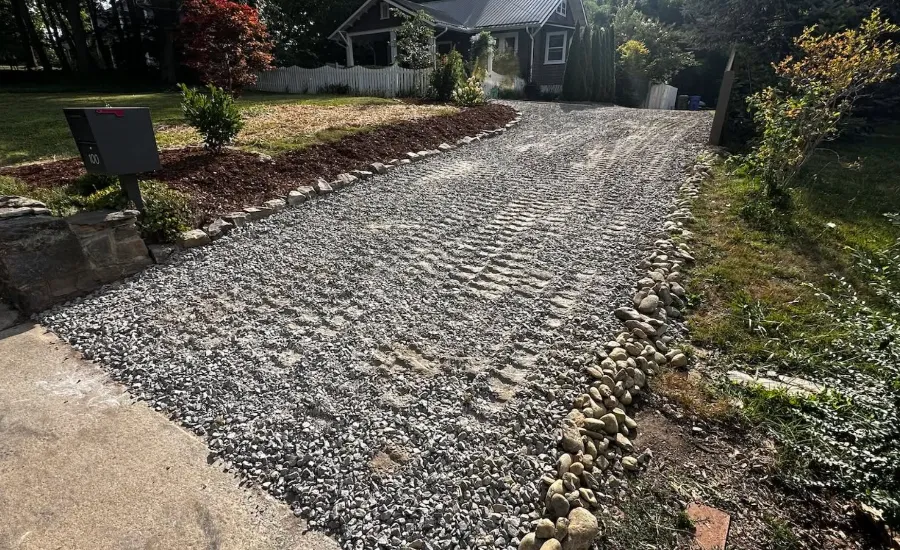
Gravel driveway cost in Western North Carolina depends mostly on length, slope, how much cutting and drainage the route needs, and how much stone it takes to build a solid base. A short drive on gentle ground is a small job, while a long drive climbing a ridge with culverts and ditches is a much bigger one, so the real number comes from walking the route.
Why gravel driveway cost varies so much here
Online price calculators assume flat ground and a short run from the road. Mountain property is rarely like that. Homes sit up hollows and on ridges, so drives are long, steep and curved, and they cross ditches and wet spots on the way up.
Two drives of the same length can be very different jobs. One follows an old farm road on firm ground. The other has to be cut into a hillside, through red clay and rock, with water crossing it in three places. That is why we price a drive on site, not by the foot over the phone. The parts below are what Ben looks at on the walk.
Length, width and turnarounds
Length is the simplest factor. More feet means more grading, more base, more surface stone and more truckloads. Width adds to it in the same way. A drive that has to take a fire truck, a delivery truck or a concrete truck during a build needs more room than one for a single car.
Parking pads and turnarounds are part of the total too. On a steep lot a turnaround is often worth it, because backing down a narrow mountain drive is no fun. Planning the pad when the drive is built costs less than adding it later, since the machine and the stone are already there.
Slope, cutting and soil
Slope changes the job more than anything else. A drive across a hillside has to be cut into the bank on the uphill side and built up on the downhill side. The cut bank may need to be laid back or held. The fill side has to be compacted in lifts so it does not slump.
Soil and rock add to it. Red clay holds water and turns soft, so a clay route needs a thicker stone base to carry weight. Rock that cannot be dug easily slows the cut. Trees and stumps along the route have to come out first, and that clearing is part of the cost. Our guide to gravel driveways on steep hills goes into grade and route.
Base stone, surface stone and compaction
Stone is a large share of the material cost, and it is sold by the ton. A drive needs a compacted base, usually ABC stone in North Carolina, and often a surface layer on top. How thick the base needs to be depends on the soil under it and the weight it will carry.
Haul distance from the quarry also matters, since every load has to be trucked in. Skimping on base is the most expensive mistake. A thin layer of stone over soft clay ruts in the first wet season, and then you pay to rebuild it. Read ABC stone vs crusher run for what each stone does.
Drainage: ditches, crowns and culverts
Water is what destroys gravel drives, so drainage is never optional on a slope. The drive is crowned or sloped so rain runs off the side. A ditch on the uphill side catches water from the hill above. Where that water has to get to the other side, a pipe goes under the drive.
Each culvert adds pipe, digging, bedding and a rock outlet. A drive that crosses a wet-weather branch or a low spot may need more than one. Where the drive meets a state road, the pipe under the entrance is sized by NCDOT. Our culvert and driveway pipe page explains how pipe goes in.
New drive or rebuild, access and season
Rebuilding a worn drive usually costs less than cutting a new one, because the route and much of the base are already there. A rebuild takes out the ruts, reshapes the crown, fixes the ditches and adds fresh stone. A drive with no base at all, or one that a storm cut to bare clay, can be close to a new build.
Access affects the price too. Tight entrances, weak bridges or soft ground can mean smaller trucks and more trips. Season matters less than people think, but wet weeks in winter and spring slow clay work. Booking when the ground is dry often makes for a better drive. Call (828) 900-1749 for a free estimate on your route.
The short version
- Length, slope, cutting, drainage and stone tonnage set most of the cost.
- Steep, curving mountain routes cost more than short drives on gentle ground.
- A thick compacted base costs more up front and far less over time.
- Every culvert, ditch and turnaround adds to the price and to the life of the drive.
- The only reliable number comes from an on-site estimate.
Quick answers
Quick answers
How much does it cost to install a gravel driveway in Western NC?
It depends on the length, the slope, how much cutting and drainage the route needs, and how much stone it takes. Ben walks the route with you and gives you a price on site, before work starts.
Do I need a permit to put gravel on my driveway?
Adding stone to a drive you already have does not usually change your road access. A new or changed entrance onto a state-maintained road needs an NCDOT driveway permit, applied for through the local District Engineer's office. In Buncombe County, disturbing an acre or more also needs an erosion control permit.
What should I put down before a gravel driveway?
A graded, compacted subgrade with a crown, then a compacted base of crushed stone such as ABC. Over very soft clay, a fabric layer under the base can help. The surface stone goes on last.
What are the downsides of a gravel driveway?
Gravel needs topping up and regrading now and then, it can wash on steep pitches, and plowing moves some stone. Good drainage cuts most of that upkeep, and gravel is far easier to repair after a storm than a cracked slab.
See our driveway installation & repair service or call (828) 900-1749.