
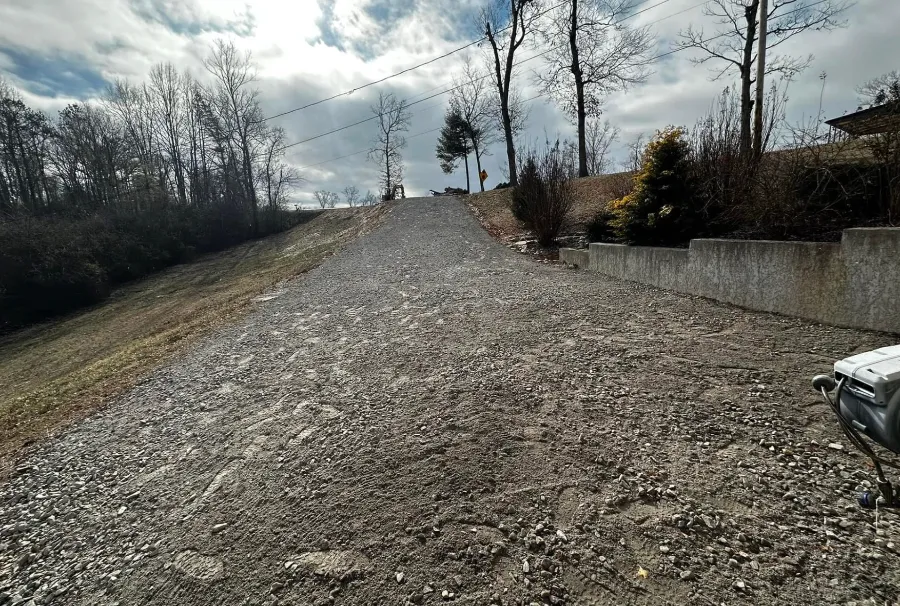
A gravel driveway on a steep hill holds up when it follows a sensible route, sits on a thick compacted stone base and sheds water off the surface at regular points instead of letting it run downhill. On a steep driveway the drainage matters more than the gravel, because running water is what strips the stone and cuts the ruts.
Why steep gravel drives wash out
On a flat drive, rain soaks in or sits in a puddle. On a steep driveway it gathers speed. Once water starts running down the wheel tracks, it carries the small stone first, then the bigger stone, and then it cuts into the clay underneath. After a few storms you have two gullies and a hump in the middle.
Adding more gravel only buys a season. The stone goes down the same path the last load did. The fix is to stop the water from travelling along the drive at all. That means shaping the surface and giving the water somewhere to leave, again and again on the way down.
Pick the route before the grade
The steepest line up a hill is the shortest, and it is almost never the right one. A drive that angles across the slope, or turns back on itself once or twice, climbs more gently. That makes it easier to drive, easier to plow and much easier to drain.
The trade-off is more cutting into the hillside and a longer drive. On mountain lots around Asheville, moving the route a little often changes how much has to be dug, how steep the worst pitch is and where water crosses. It pays to walk several lines before choosing one. There may also be local rules on drive grade for fire and emergency access, so ask the county planning or fire marshal's office about your lot.
A base that stays put
Steep drives take more stress than flat ones. Tires spin and push stone downhill when climbing, and braking drags it down when descending. A loose layer of round stone on top of clay will not stay.
The answer is a compacted base of crushed stone, usually ABC in North Carolina, rolled tight so the angular pieces lock together. The fines in the mix fill the gaps and help it set up hard. On soft clay the base needs to be thicker. Our guide to ABC stone and crusher run explains why angular stone with fines grips better than clean stone on a slope.
Shed the water at every chance
The surface should be crowned or tipped to one side so rain runs off instead of down the middle. A ditch along the uphill edge catches water coming off the slope above before it reaches the drive.
That ditch water has to cross somewhere. On a long steep drive, it crosses in several places through a pipe set under the drive, with rock at the outlet so it does not carve a gully down the hill. Some drives also use broad, shallow dips that turn surface water off the side. Read the driveway culvert guide for how pipe is sized and set.
Hold the banks above and below
Cutting a drive into a hillside leaves a bank on the uphill side and a fill slope on the downhill side. Both can fail. A cut bank that is too steep sheds soil onto the drive and into the ditch. A fill edge that was not compacted slumps and takes the shoulder with it.
Cut banks can be laid back to a gentler angle, covered with rock or seeded and protected until the grass holds. Where there is not room to lay the slope back, a wall may be the answer. Our slope stabilization work covers holding banks like these.
Winter on a steep drive
The steepest drive on the road is the one that stays iced up longest. Snow packs into ruts, and a drive that holds water freezes worse. Good drainage helps in winter too, because a dry drive has less to freeze.
Plowing gravel takes care. A blade set too low peels off the top stone, and a steep drive loses it fastest. This winter our crew is offering snow removal around Leicester, Asheville and Weaverville, with steep drives and private roads on the list. In spring, a light regrade puts back any stone the plow moved.
The short version
- On a steep driveway, water control matters more than the type of gravel.
- A route that angles across the slope drains and drives better than a straight climb.
- Use a thick, compacted base of angular crushed stone with fines.
- Crown the surface, ditch the uphill side and pipe water across at several points.
- Check with the county about grade limits for fire and emergency access.
Quick answers
Quick answers
How steep can a gravel driveway be?
It depends on the route, the surface and local rules for emergency access. Some fire codes limit driveway grade, so ask your county planning or fire marshal's office. A gentler route is easier to drive, drain and plow.
What kind of gravel works on a steep driveway?
Angular crushed stone with fines, such as ABC, compacted hard. It locks together and resists spinning tires. Round or washed stone rolls and migrates downhill on a slope.
How do I stop gravel washing down my steep driveway?
Stop water running along the drive. Crown or tip the surface, cut a ditch on the uphill side, and pipe the water under the drive at several points with rock at each outlet.
Can you fix a steep driveway that keeps rutting?
Usually, yes. The ruts are cut out, the surface is reshaped with a crown, the ditches are cleaned or cut, and fresh base stone is spread and compacted.
See our driveway installation & repair service or call (828) 900-1749.