
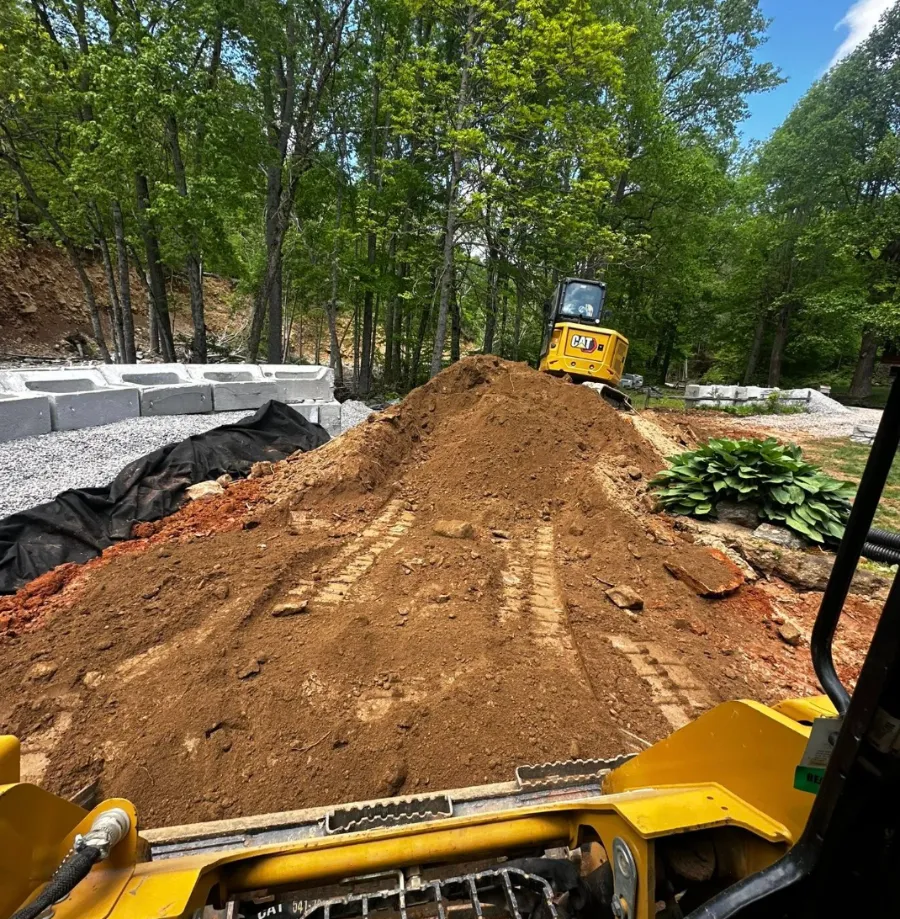
Fill dirt is subsoil with little organic matter, used to raise grade, fill holes and build pads because it compacts and stays put. Topsoil is the dark, living top layer that grows grass and plants, so it goes on last and in a thin layer, never under a building, a slab or a drive.
What fill dirt is
Fill dirt is the soil from below the surface layer. It has little or no organic material, such as roots, leaves and humus. That is the point. Organic matter rots and shrinks over time, so soil without it can be packed down and will stay at that height.
Fill is used to raise low ground, level a yard, backfill around a foundation or trench, and build up the low side of a building pad. In Western North Carolina, a lot of fill is red clay subsoil, sometimes with rock mixed in. Good fill is free of trash, stumps, large roots and big boulders that leave voids.
What topsoil is
Topsoil is the top few inches of ground, where roots grow and organic matter builds up. It is darker, looser and full of life, which is exactly what grass, gardens and shrubs need. It holds water and nutrients well.
Those same qualities make it a poor base for anything heavy. It compresses, it holds water, and its organic content keeps breaking down. Put topsoil under a shed pad and the pad sinks. On good sites, the existing topsoil is scraped off before grading, kept in a pile and spread back once the grading is done. That saves buying it in later.
Fill dirt vs topsoil: where each one goes
Use fill dirt to raise grade, fill holes and old foundations, build up the low side of a pad, backfill walls and trenches, and reshape a yard so water drains away from the house. Use topsoil as the final layer over that fill where you want grass, a garden or plantings.
A common layout for a regraded yard is compacted fill shaped to the right slope, with topsoil spread on top and then seeded. Under a building pad, a drive or a slab, there should be no topsoil at all. Those get compacted fill and then stone. Our grading and site prep work includes stripping and replacing topsoil in that order.
Red clay as fill
Red clay is what most of Western North Carolina has under the surface, so it is the most common local fill. It has real strengths. It compacts tight and holds a shape well, which suits pads and backfill.
It has drawbacks too. Clay holds water, turns soft and slick when wet and is hard to compact in a rainy spell. It also sheds water fast on bare slopes, so a clay fill slope needs seeding and erosion protection quickly. Place clay fill when it is not soaked, in thin layers, compacted as you go. Dumped in one thick pile, it settles unevenly for years.
Compaction: why fill is placed in lifts
The difference between fill that holds and fill that sinks is compaction. Fill is spread in thin layers, called lifts, and each layer is compacted before the next goes on. A thick pile that is only rolled on top stays loose underneath.
That matters most under anything built. A pad, a slab or a drive on poorly compacted fill will crack or dip. On sloped lots it matters even more, because the fill side of a pad is what the building settles toward. See our building pad and foundation prep page for how pads are built up and compacted.
Ordering fill dirt delivery
Before you order, know what the dirt is for. Fill for a pad or backfill should be clean and compactable. Fill for a low spot in a yard still needs topsoil on top. Ask where the fill came from, so you are not paying for stumps, trash or rock.
Then think about access. A loaded dump truck is heavy, so a soft lawn, a septic field or a weak culvert is not the place to drive it. A pile dumped at the road may be fine, but spreading, shaping and compacting it is the real work. We haul fill in and spread it where it is needed as part of the job. See hauling services or call (828) 900-1749 for a free estimate.
The short version
- Fill dirt is low in organic matter and compacts, so it raises grade and supports pads.
- Topsoil grows plants, so it goes on last and never under a building or drive.
- Red clay makes workable fill if it is placed dry and compacted in thin layers.
- Strip and save existing topsoil before grading, then spread it back.
- Spreading and compacting fill is the real work, not just the delivery.
Quick answers
Quick answers
Can I use topsoil as fill dirt?
Not under anything built. Topsoil is full of organic matter that breaks down and settles. Use it only as the top growing layer over compacted fill.
Is red clay good fill dirt?
It can be. Red clay compacts tight and holds a shape, but it must be placed when it is not soaked, in thin compacted layers, and protected from erosion on slopes.
How much fill dirt do I need?
It depends on the area and how much the grade has to rise, plus extra because fill compacts. We work that out on site as part of the estimate.
Do you deliver and spread fill dirt?
Yes. We haul fill in and spread, shape and compact it where it is needed, usually as part of grading, pad or drainage work.
See our hauling service or call (828) 900-1749.