
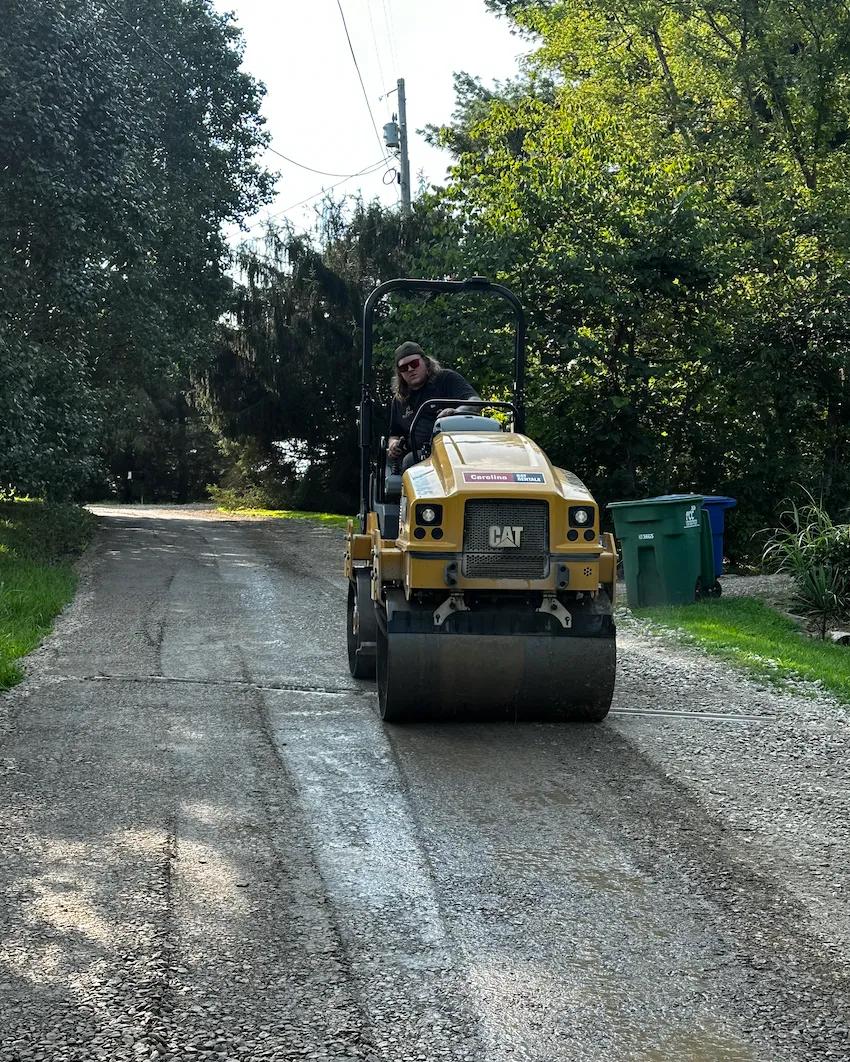
ABC stone and crusher run are close cousins: both are crushed stone mixed with fine dust, which is what lets them pack down hard. In North Carolina ABC stands for aggregate base course, and for a gravel driveway it is the usual choice for the compacted base, often with a cleaner stone spread on top.
What ABC stone is
ABC is short for aggregate base course. It is the name NCDOT uses for the base layer under its roads, and the name stuck with quarries and contractors across the state. The department's own sampling manual describes it as a base of approved aggregate that is hauled in, placed, mixed and compacted.
In practice, ABC is crushed stone in a range of sizes, from pieces you could hold in your palm down to grit and dust. The mix of sizes matters. The big pieces carry the load, the smaller ones fill the gaps, and the fines bind it all together when it is wet and rolled. That is why ABC sets up firm instead of staying loose.
What crusher run is
Crusher run is the material that comes off the crusher before it is screened into separate sizes. You get everything from the larger stone down to the dust, all in one load. In some regions it goes by other names, such as dense grade or quarry process.
That description sounds a lot like ABC, and in practice the two overlap. The main difference is that ABC is made to meet a state gradation spec, while crusher run is a trade name that varies from quarry to quarry. One quarry's crusher run may be very close to ABC. Another's may have more dust or bigger pieces. If you are buying stone, ask the quarry what it actually is.
How they compare on a driveway
Both make a good driveway base. Compacted in layers, either one forms a hard, interlocked surface that sheds water and carries trucks. Both are dusty when dry and both can get a little sticky on top in a long wet spell, because the fines come up to the surface.
On a steep driveway, angular stone with fines is what you want, because it locks together and resists spinning tires. Clean round stone does the opposite. Where ABC wins is consistency. Since it is made to a spec, you know what you are getting from load to load. Read our steep driveway guide for more on stone on slopes.
Base stone vs surface stone
Many drives use two layers. The base is ABC or a similar dense mix, rolled hard. The top is sometimes a cleaner, washed stone such as #57, which is a uniform size with no dust. Clean stone drains fast and keeps mud off your boots, but on its own it rolls and moves under tires.
Put clean stone on top of a good base and you get both: a firm drive that does not track mud. On a steep pitch, though, a loose top layer drifts downhill, so a compacted ABC surface often works better there. Larger rock has its place too, lining ditches and pipe outlets where water runs fast.
Which stone goes where
A rough guide for a gravel drive in Western North Carolina. The compacted base takes ABC or a dense crusher run. The surface takes either more ABC, rolled hard, or a thin layer of clean stone on gentle grades. Ditch lines and culvert outlets take larger rock that water cannot move.
Parking pads and shed pads follow the same pattern, a compacted dense base with or without a cleaner top. Our building pad work finishes pads for sheds and outbuildings with compacted stone. How thick each layer should be depends on the soil under it, so that is set on site, not from a chart.
Ordering and spreading the stone
Stone is sold by the ton, and the amount depends on the length, width and depth of each layer. Red clay underneath usually calls for a thicker base than firm, well-drained ground. Haul distance from the quarry adds to the cost of every load.
Dumping a pile of stone on a drive is not the same as building one. The subgrade has to be shaped first, then the base spread in layers and compacted, then the surface finished with a crown so water runs off. We bring stone in and spread it as part of driveway and pad work; see hauling for what we truck in. Call (828) 900-1749 for a free estimate.
The short version
- ABC means aggregate base course, the NCDOT name for compacted base stone.
- Crusher run is a similar mix of crushed stone and fines, but it varies by quarry.
- Either makes a good driveway base when spread in layers and compacted.
- Clean stone such as #57 drains well on top but rolls on steep pitches.
- Larger rock belongs in ditches and at pipe outlets where water runs fast.
Quick answers
Quick answers
Is ABC stone the same as crusher run?
They are very similar. Both are crushed stone with fines. ABC is made to a North Carolina spec for base course, while crusher run is a trade name that varies by quarry, so one load can differ from the next.
What gravel is used for driveways in North Carolina?
Most drives here are built on a compacted ABC base. Some get a top layer of clean washed stone such as #57 on gentler grades, and larger rock is used in ditches and at pipe outlets.
Should I use #57 stone or ABC on my driveway?
Use ABC for the base, since it packs hard. #57 can go on top for a cleaner, better-draining surface on gentle ground. On steep pitches, a compacted ABC surface usually stays put better.
Does ABC stone get muddy?
The fines can feel soft on top during a long wet spell, but a well-compacted, crowned ABC drive stays firm. A drive that turns to mud usually has a drainage problem or too little base over clay.
See our driveway installation & repair service or call (828) 900-1749.