
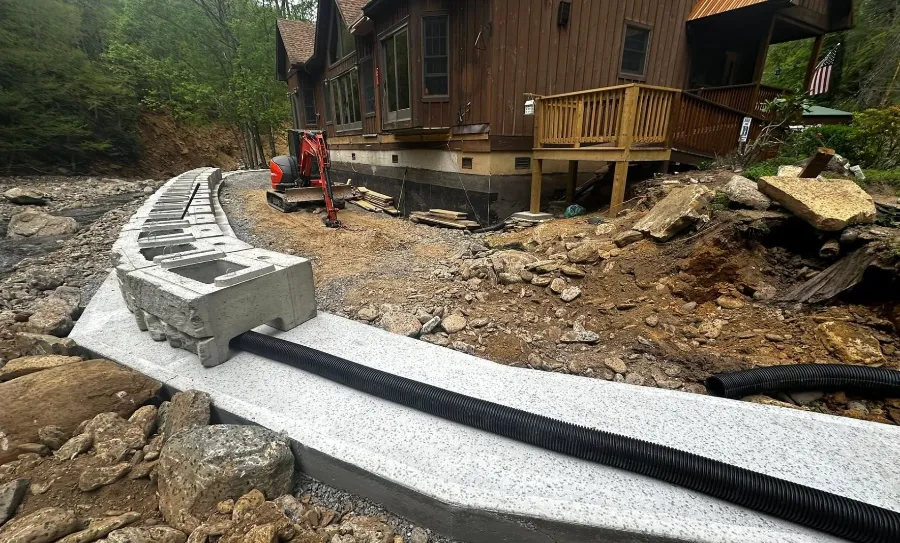
A retaining wall needs a way for water to get out from behind it, usually a perforated drain pipe at the base, clean stone behind the blocks and fabric to keep soil out of that stone. Without it, water pressure builds in the soil and pushes the wall out of line, which is why most failed walls are really failed drainage.
Why water is the real load on a wall
Dry soil pushes on a wall. Wet soil pushes much harder. When rain soaks the ground behind a wall, the water adds its own weight and fills the gaps between soil particles. That extra pressure works on every course, all the way down.
Clay makes it worse. Red clay, common across Western North Carolina, drains slowly and swells when wet. Water that cannot escape sits against the back of the wall for days. Repeat that through a few wet seasons and freeze cycles, and even a well-built face starts to lean. Good drainage keeps the soil behind the wall from turning into that heavy, wet load.
The parts of a wall drainage system
A working system has a few layers, and each one has a job. At the bottom, behind the first course, a perforated drain pipe collects water and carries it away. Around that pipe and up the back of the wall goes clean, angular stone with no fine dirt in it. Water moves through it easily.
Between that stone and the native soil goes filter fabric. It lets water pass but keeps clay from washing into the stone and clogging it. At the very top, a layer of soil or a cap slows surface water from pouring straight down behind the blocks. Skip any of these and the system loses ground over time.
Where the water goes once it is out
Collecting water is only half the job. The pipe has to empty somewhere it can do no harm. That usually means running it to daylight at a lower point on the property, with rock at the outlet so the flow does not cut a new gully.
The outlet should not dump water toward a foundation, onto a drive or across a neighbor's yard. On a steep lot, that often ties into a swale or ditch that carries the water away. Our drainage and water diversion work covers that part, so the wall and the outlet are planned together.
Does a 4 ft retaining wall need drainage?
Yes. A four foot wall holding back soil needs drainage just as a taller one does. The pressure is lower than on a big wall, but in clay and steady mountain rain it is still enough to tip blocks, push out the middle of the wall or wash soil through the joints.
The only walls that can sometimes get by without a full drain system are very low edging walls in sandy, free-draining ground. That is rare around Asheville. For any wall holding a yard, a drive or a building pad, the drain pipe, stone and fabric are worth far more than they cost.
Stop surface water before it reaches the wall
A lot of the water behind a wall comes from above it. Roof downspouts, a driveway that sheds toward the wall, or a slope that funnels rain down onto the backfill can overload even a good drain.
The fix is to catch that water first. A shallow swale above the wall, downspouts piped past it, and grading that turns runoff to the side all lower the load. On bigger properties this becomes a stormwater and runoff question. Handled early, it means the wall drain only deals with the water that soaks in.
Signs a wall's drainage is failing
Walls give warnings before they fail. A bulge in the middle of the face, a top course that leans out, or blocks that have shifted out of line all point to pressure building behind them.
Watch for water seeping through the joints long after a storm, soil washing out at the base, or a soggy strip along the top of the wall that never seems to dry. A sinking area behind the wall can mean soil is being carried away through the face. Any of these is worth a look before the next heavy rain, especially if the wall holds up a drive, a deck or part of the house.
Fixing an old wall or building a new one right
Drainage is hard to add after the fact. On many failing walls, the honest fix is to take down the affected section, dig out the wet backfill and rebuild with pipe, stone and fabric in place.
On a new wall it goes in as the courses rise, which is how every block retaining wall we build is done. If you want to know what a wall with proper drainage costs, our retaining wall cost guide lays out what moves the price. For a free look at your wall or slope, call (828) 900-1749.
The short version
- Water pressure behind a wall is the main reason walls lean and fail.
- A drain system has a perforated pipe, clean stone, filter fabric and a safe outlet.
- A 4 ft wall holding soil needs drainage too, especially in clay.
- Catching surface water above the wall takes load off the drain.
- Bulging, leaning and seeping faces are early signs of failing drainage.
Quick answers
Quick answers
Does a 4 foot retaining wall need drainage?
Yes. In the clay soils around Asheville, any wall holding back soil should have a drain pipe at the base, clean stone behind it and fabric against the native soil. A shorter wall carries less pressure, but enough to move blocks over time.
What kind of gravel goes behind a retaining wall?
Clean, angular crushed stone without fine dirt mixed in. It lets water drop to the drain pipe quickly and packs firmly against the back of the blocks.
Do block retaining walls need weep holes?
A block wall with a drain pipe and stone column behind it usually lets water out through the pipe instead. Water can also pass through the joints between blocks. What matters is that water has a clear way out.
Can drainage be added to an existing retaining wall?
Sometimes surface water can be redirected above the wall to take load off it. Adding a real drain behind the wall usually means taking down and rebuilding the affected section.
See our retaining walls service or call (828) 900-1749.