
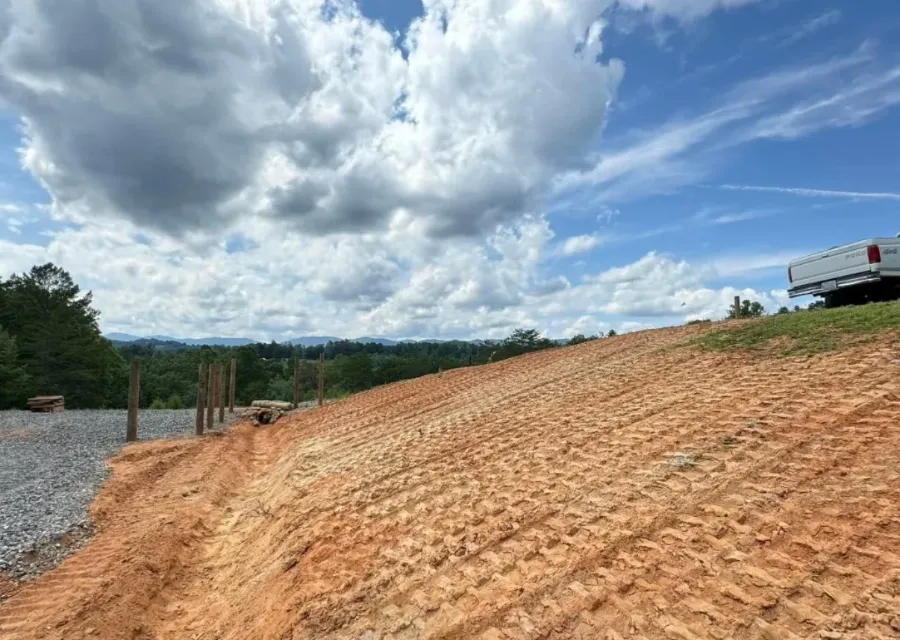
To stop erosion on a steep slope, control the water coming onto it, cover the bare soil, and ease or support the grade where it is too steep to hold itself. On Western North Carolina hillsides that usually means a mix of diversion above the slope, seed and mulch or rock on the face, and regrading or a retaining wall where the ground keeps moving.
Why mountain slopes wash out
A slope erodes when water moves faster than the soil can hold together. On a steep hillside, rain picks up speed quickly. If the ground is bare, it carries soil with it. If water soaks in and has nowhere to go, the whole face can get heavy and slump.
Red clay adds to the problem. It sheds water on top and holds it underneath, so the surface washes while the subsoil gets slick. Fresh cuts from a drive or a house pad expose that clay. Hurricane Helene showed how quickly saturated hillsides here can give way when a heavy storm stalls over them.
Hillside erosion control starts above the slope
The first fix is usually not on the slope at all. It is at the top. Water from a roof, a drive or the hill above should be caught and sent around the face, not over it.
That can mean a shallow swale or berm along the crest, downspouts piped to a safe outlet, or a drive regraded so it stops shedding onto the bank. Each of those leaves the slope with only the rain that lands on it. Our stormwater and runoff work handles the bigger version of this, where a whole hillside drains across a property.
Erosion control methods for the face of the slope
Bare soil is the enemy. Once water is under control, the face needs cover. On moderate grades, seed with straw mulch can hold until roots take over. Erosion control blankets are another option on steeper ground, pinned over seed to stop rain from washing it off.
Where water still runs across the face, rock does the work. A rock-lined channel carries runoff down the slope without cutting a gully. Rock armor at the toe stops the base from washing out. Silt fence at the bottom catches sediment from fresh work, but it does not hold the slope. It only keeps the mud on your side of the line.
When regrading is the right call
Some slopes are simply too steep for cover alone. Grass and mulch cannot grip a face that keeps sloughing off. In that case, the answer is to change the shape.
Regrading lays the slope back to an angle the soil can hold, or breaks a long slope with a flatter bench that slows the water. It also lets us fix low spots where water pools and soaks in. That takes room. On a tight lot with a house or drive close to the top, there may not be space to lay the slope back. That is where a wall comes in.
When a retaining wall is the answer
If the slope cannot be eased because something sits above or below it, a wall can hold the grade instead. A block wall on a compacted base turns a steep bank into a level step, with the soil behind it supported.
A wall only works if water can get out from behind it. Drain pipe, clean stone and fabric are part of every wall we build. Our retaining wall drainage guide explains why. Taller walls, and walls holding a structure or a road, can need an engineered design, which Ben will raise at the estimate.
Signs a slope is moving, not just washing
Surface erosion looks like small rills, bare patches and mud at the bottom of the slope. A moving slope looks different. Watch for cracks along the top, trees leaning downhill, a bulge at the toe, or wet seeps that appear partway down the face.
Fences and walls that tilt, or a drive edge that drops, point the same way. If a slope above or below a house shows any of these, have it looked at before the next heavy rain. Slumping ground near a home can be urgent, and early repairs are usually simpler than a slide cleanup.
Rules and timing on steep ground
In Buncombe County, lots in a hillside subdivision need an erosion control permit at a quarter acre of disturbance, compared with one acre on most sites. The county also lists slopes that exceed limits on steepness as a common reason for rejecting a plan. Our land disturbance permit guide covers the process.
Timing matters too. Slopes graded late in the fall can sit bare through winter rains. Where possible, plan the work so the face gets covered quickly. For a free look at your slope, call (828) 900-1749.
The short version
- Divert water at the top of the slope before working on the face.
- Bare soil needs cover fast: seed and mulch, blankets or rock.
- Silt fence catches sediment but does not hold a slope.
- Regrade where there is room, and use a drained block wall where there is not.
- Cracks, leaning trees and bulges at the toe mean the slope is moving.
Quick answers
Quick answers
How do I stop soil erosion in my yard?
Find where the water comes from and send it around the bare ground, then cover the soil with seed and mulch or rock. If water keeps channeling in one path, give it a lined route off the property.
How much does erosion control on a slope cost?
It depends on the size and steepness of the slope, how much water reaches it, access for machines, and whether it needs regrading, rock or a wall. A free estimate gives you a real number for your slope.
Does silt fence stop erosion on a hillside?
No. Silt fence catches sediment at the bottom of disturbed ground so it does not leave the site. Holding the slope takes water control and cover on the face.
What should I do if my slope is slumping toward the house?
Treat it as urgent. Keep water away from the top of the slope if you can and call for a site visit before the next heavy rain.
See our slope stabilization service or call (828) 900-1749.