
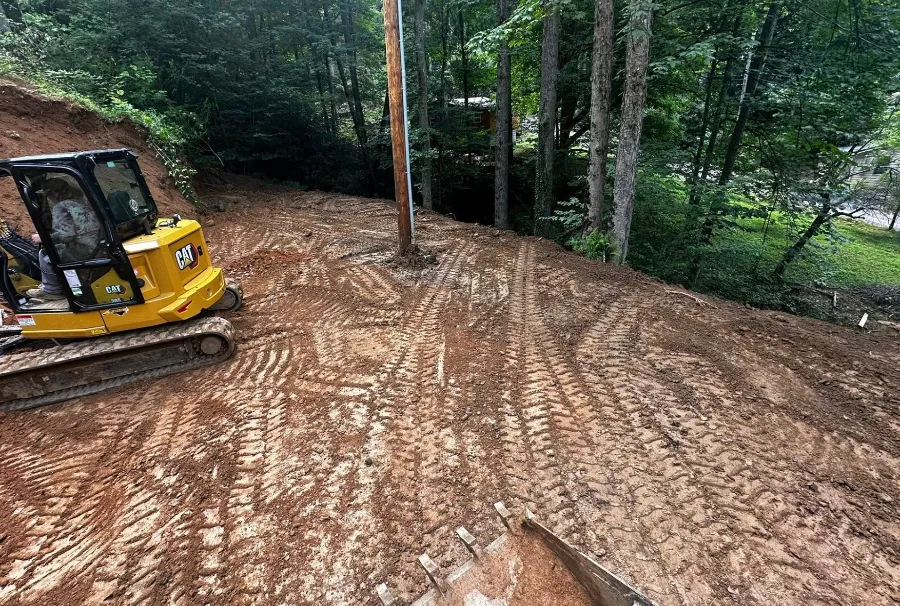
Building on a steep lot in Western North Carolina works well when the earthwork is planned first: the building pad is usually part cut and part fill, the drive has to climb to it, and every bit of runoff needs a planned path. Expect more site work than on flat ground, and plan the pad, drive, septic area and drainage together before any dirt moves.
What a steep lot changes
Mountain lots offer views and privacy, but a slope changes almost every part of the site work. There is more dirt to move, banks to hold, and water to manage. Trucks and machines need a way up. Even the septic field and utility lines have to fit the contours.
None of that is a reason not to build. It is a reason to look closely before you buy or design. A house plan that suits a flat lot can force huge cuts on a hillside. A plan that steps with the ground, or sits along the contour, often needs far less earthwork. Bring your builder and your excavator onto the lot early.
The building pad on a slope
On a hillside, a building pad is cut into the uphill side and the spoil is often used to build up the downhill side. That balances the dirt, but it puts the house partly on cut ground and partly on fill. Fill that was dumped instead of placed in thin layers and compacted will settle, and the house settles with it.
The cut bank behind the pad needs attention too. It has to be stable, and the water coming off it has to be caught before it reaches the foundation. Our building pad and foundation prep page covers how pads are built in lifts and shaped to shed water.
Getting a drive and trucks up the hill
Before anything is built, concrete trucks, lumber deliveries and the crew all need to reach the pad. On a steep lot the drive is often the hardest part of the job. Its route sets how much has to be cut, how steep it climbs and where the water crosses.
A construction entrance that also becomes the finished drive saves money, as long as it is built properly from the start: graded, based with stone and given ditches and pipe. Our guide to gravel driveways on steep hills covers route, grade and drainage in detail.
Holding the slope: walls and laid-back banks
Every cut leaves a bank, and every fill leaves an edge. Where there is room, a bank can be laid back to a gentler angle and seeded or covered with rock. Where there is not, because the house, the drive or the property line is too close, a retaining wall holds the grade.
Walls on mountain lots work hard. They need a solid base, drainage stone and pipe behind them so water cannot build up pressure. Our block retaining walls are built that way. Planning walls with the pad, rather than adding them after a bank slumps, usually costs less and looks better.
Water, erosion and permits
Once trees and topsoil come off a slope, rain runs faster and carries soil with it. Silt fence, diversions and quick seeding protect the site while it is open. Final grading has to send water around the house and down the hill in a controlled way.
In Buncombe County, outside the City of Asheville, the county's erosion control page says a permit is required for land-disturbing activity of one acre or more. Lots in a Hillside Subdivision, as the county's subdivision ordinance defines it, need one at a quarter acre of disturbance. Inside Asheville, ask the city. Other counties set their own rules, so call the local planning office before grading.
Septic, utilities and the order of work
Many mountain lots are not on sewer. Septic work starts only once the county has issued a permit and approved a design. Where it can go is decided by slope, soil and rock, so on a steep lot locate it before you place the house and drive.
Trench water, power and other lines along with the rest of the site work so finished ground is not dug up again. For the full order of work, from clearing to final grade, see how to prepare land for construction in WNC.
What drives the site work cost
On a steep lot, the main cost drivers are the amount of cut and fill, rock, the length and difficulty of the drive, walls, and drainage. Clearing, haul-off of spoil and any imported fill or stone add to it. Access for machines on a tight or very steep site can slow everything.
The way to keep the cost down is to fit the house to the ground. A smaller cut, a shorter drive and a pad that balances its own dirt all save money. Ben will walk the lot with you and price the site work for free before anything starts. Call (828) 900-1749.
The short version
- Fit the house to the slope to cut down on earthwork, walls and cost.
- Fill under a building pad must be placed in thin layers and compacted.
- Plan the drive, pad, septic area and drainage together before grading.
- Buncombe County requires an erosion control permit at one acre of disturbance, or a quarter acre in a Hillside Subdivision.
- Cut banks need laying back, rock cover or a retaining wall.
Quick answers
Quick answers
Is it more expensive to build on a sloped lot?
The site work usually costs more, because of cut and fill, walls, a longer drive and drainage. A house designed to fit the slope can narrow the gap a lot.
Do I need a permit to grade a steep lot in Buncombe County?
Outside Asheville, the county requires an erosion control permit for one acre or more of disturbance, or a quarter acre in a Hillside Subdivision. Inside Asheville, check with the city. Building and septic permits are separate.
What is a building pad?
The level, compacted area a house, garage or shop sits on. On a slope it is cut into the hill on one side and built up with compacted fill on the other.
Do I need a retaining wall to build on a hillside?
Not always. Where there is room, banks can be laid back and seeded or covered with rock. A wall is needed where the house, drive or property line leaves no room for a gentler slope.
See our building pads service or call (828) 900-1749.