
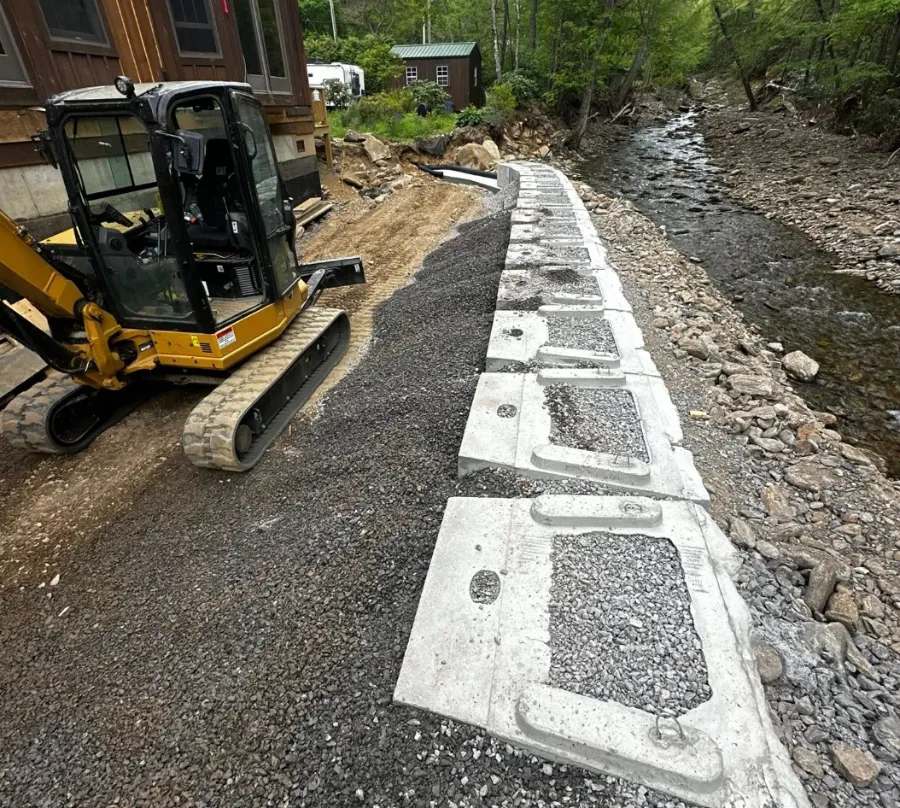
Block walls give the most predictable, straight and well-drained result, boulder walls suit a natural look where big stone is on hand, and timber walls are the shortest lived because wood rots in wet ground. Hazy River Earthworks builds block retaining walls, and this guide compares all three honestly so you can choose.
How each type holds the hill
All three are usually gravity walls. They hold soil back through their own weight and a slight lean into the slope. What changes is how the pieces lock together.
Block walls use concrete units that stack in a set pattern, each course stepping back a little. Boulder walls rely on big stones fitted against each other, with smaller stone packed behind. Timber walls stack treated wood and tie it back into the hill with anchors buried behind the face. Each can work. The question is how long it keeps working on a wet, steep Western North Carolina lot.
Block retaining walls
Segmental block is made to a fixed size, so every course sits level and the wall goes up straight or follows a smooth curve. Large block is heavy enough that it has to be set by machine, and that weight is part of its strength.
Block also makes drainage simple to build in. A drain pipe runs along the base, clean stone fills the space behind each course, and fabric keeps the clay out of that stone. Tiers and steps are easy to lay out. For taller walls, block systems can be designed by an engineer. This is the type Hazy River Earthworks builds, and it is the one we would put below a house or beside a drive.
Boulder retaining walls
A boulder wall uses large natural rock, stacked and fitted so each stone bears on the ones below. Done well, it looks like it belongs on a mountain lot. It also hides small shifts better than a straight block face.
The catch is consistency. Every stone is a different shape, so the fit depends on the supply of rock and the eye of whoever sets it. Gaps between boulders can let soil wash through unless fabric and stone are placed carefully behind them. Height is limited by how big the boulders are, and getting large rock to a steep backyard takes heavy equipment.
Timber retaining walls
Timber walls use pressure-treated landscape timbers or beams, stacked and pinned, with anchors running back into the slope. They go up quickly with light equipment, which is why they show up on so many older lots.
Wood in wet ground is the weak point. Around here the soil stays damp much of the year, and red clay holds that moisture against the wall. Over time the timbers soften, the anchors loosen and the wall starts to lean. Replacing a failed timber wall means digging it out, so the cost comes back later. For a low garden bed it can be fine. For anything holding up a drive or a house, it is a short-term answer.
Which one fits a Western NC slope
Mountain lots put walls under hard conditions: steep grades, heavy rain and clay that turns slick when soaked. Hurricane Helene showed how fast saturated ground can move.
On ground like that, the wall needs a solid base, drainage that keeps working and a shape that resists the push of wet soil. Block handles all three in a way that is easy to check and repeat. Boulders can do the job where the look matters and large stone is close by. Timber is the one we would steer people away from for any wall they need to rely on.
Drainage matters for all three
Whatever the face is made of, water is the load that pushes walls over. Soil behind a wall gets heavier when it is wet, and that weight presses on every course.
A drain pipe at the base, clean stone behind the face and fabric against the native soil let that water leave before the pressure builds. Our retaining wall drainage guide walks through each layer. If a wall of any type is leaning or bulging, drainage is the first thing to check.
Choosing and getting a price
Start with what the wall is holding. A flower bed, a yard, a parking pad and a house foundation ask very different things of a wall. Then look at height, access and how wet the ground stays.
The retaining wall cost guide explains what moves the price. If you want a block wall built on a proper base with drainage behind it, see our retaining walls service and call (828) 900-1749. Ben will walk the slope with you and give you a price before any work starts.
The short version
- Block walls are the most predictable and the easiest to drain well.
- Boulder walls give a natural look but depend on rock supply and fitting skill.
- Timber walls rot in wet mountain clay and need replacing sooner.
- Every wall type needs drainage behind it to stay straight.
- Hazy River Earthworks builds block retaining walls across Asheville and WNC.
Quick answers
Quick answers
Which type of retaining wall lasts the longest?
A block or boulder wall on a proper base with working drainage will outlast a timber wall in wet ground. Wood breaks down over time, while concrete block and stone do not rot.
Are boulder walls less costly than block walls?
It depends on how close good rock is, how far it has to be moved on site and how tall the wall is. Ask for both priced on the same wall line if you are weighing them up.
How long does a timber retaining wall last?
That depends on the wood, its treatment and how wet the soil stays. In damp clay, timber is usually the first wall type to lean or soften, which is why it suits low garden beds more than structural walls.
What kind of retaining walls does Hazy River Earthworks build?
Block retaining walls, including large block set by machine, on a dug and compacted base with drain pipe, clean stone and fabric behind them.
See our retaining walls service or call (828) 900-1749.