
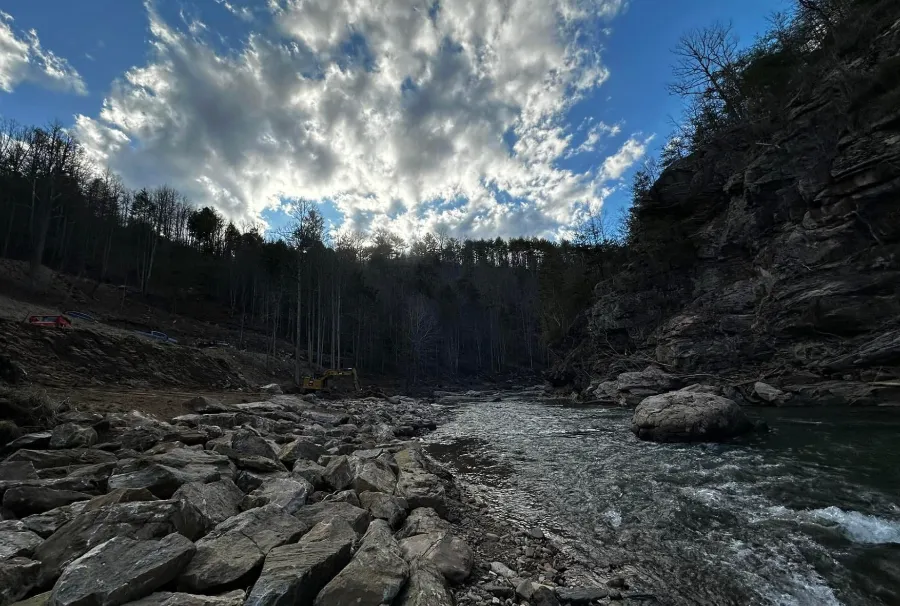
Often, yes. Placing rock or fill in a creek is regulated by the US Army Corps of Engineers, and the state pairs that with a water quality certification. Along trout waters North Carolina protects a 25 foot buffer from the top of the bank, and grading or fill in the floodplain beside the creek can need a county permit. Many small bank repairs fit an existing general permit, but you need to know which rules apply before a machine goes in.
Want this done for you? Hazy River Earthworks rebuilds washed-out creek and river banks around Leicester, Asheville, Marshall and across Western North Carolina, and the permit questions are talked through at the free estimate. See our creek & river bank repair service.
Work in the creek: the Army Corps
Buncombe County's erosion control FAQ is plain about it: work inside a stream needs a US Army Corps of Engineers permit. In North Carolina that is the Corps' Wilmington District. Rock placed at the toe of a bank, fill pushed below the water line and a new channel cut all count as work in the stream.
Most bank repairs do not need a custom permit. The Corps runs nationwide permits for common jobs, and Nationwide Permit 13 covers bank stabilization. The current set of nationwide permits took effect on March 15, 2026. Some jobs under a nationwide permit can go ahead without paperwork to the Corps, while longer or heavier repairs need a notice to the Corps before work starts. Jobs that do not fit at all need an individual permit with a public notice, which takes far longer.
The state side: a 401 water quality certification
A Corps permit in a creek comes with a state water quality certification from the NC Division of Water Resources, often called a 401 certification. For each nationwide permit the state issues a matching general certification. For Nationwide Permit 13, that is General Certification 8568, effective March 15, 2026.
The general certification has its own conditions, and some jobs must still notify the state. Read them, or have whoever is handling the paperwork check them, before the job is scheduled.
Trout waters and the 25 foot buffer
Many mountain creeks carry a trout classification. State erosion control rules require a 25 foot undisturbed buffer along trout waters, measured from the top of the bank, and NC DEQ guidance says the buffer applies no matter how small the project is.
A limited, temporary disturbance in the buffer is allowed: no more than 10 percent of the buffer length on the tract, and no more than 100 linear feet in any 1,000 feet. Anything bigger needs a trout buffer waiver. That waiver comes from the state regional engineer in the Division of Energy, Mineral and Land Resources, not from the county, and there is no deadline for the review, so allow time.
Timing: the trout moratorium
Season matters on trout streams. NC DEQ's trout buffer guidance tells applicants to check with the NC Wildlife Resources Commission on whether a moratorium on in-stream work from October 15 to April 15 applies to their creek. It protects spawning fish.
If your bank washed out this year and the creek carries trout, ask early. A repair planned for winter may have to wait for spring, or be planned so the in-stream part falls outside the window. Work up on the bank, away from the water, is a separate question.
Floodplain permits on the land beside the creek
The ground next to a creek is often mapped floodplain. Buncombe County's Flood Damage Prevention Ordinance covers development in the 100 year floodplain, including grading and filling, and the county says that in most cases grading there needs a Flood Development Permit. In the floodway itself, nothing can be built or filled without an engineered no impact study.
The county Floodplain Administrator works out of Planning and Development at 35 Woodfin Street in Asheville. Madison, Haywood and Henderson counties and the towns run their own permit offices, so ask the one that covers your address. Larger jobs also fall under the land disturbance permit rules.
How we handle the permit questions
Bank work starts with a free site visit. Ben walks the creek with you to see where the current is cutting and what sits behind the bank: a yard, a drive, a house or a private road. Permits are raised at the estimate, and who obtains each one is agreed before the job starts.
On the job, fallen trees and flood debris come out first and are hauled off. The bank is then shaped and rebuilt with rock, and the ground behind it is regraded so runoff no longer pours over the edge. For the repair methods themselves, read how to stop creek bank erosion and our guide to riprap for creek banks.
The short version
- Work inside a stream needs a US Army Corps of Engineers permit.
- Many bank repairs fit Nationwide Permit 13, but some need a notice to the Corps first.
- The state pairs it with a water quality certification, General Certification 8568 for bank work.
- Trout waters carry a 25 foot buffer from the top of the bank, and bigger disturbance needs a state waiver.
- Check the Wildlife Resources Commission's October 15 to April 15 trout moratorium before planning winter work.
- Grading or fill in the floodplain usually needs a county floodplain permit.
Quick answers
Quick answers
Do I need a permit to put rock on my creek bank?
Rock placed in the creek or below the water line is work in the stream, and Buncombe County says that needs an Army Corps permit. Many small repairs fit a nationwide permit, so check which one applies before starting.
Who issues creek permits in Western NC?
The US Army Corps of Engineers for work in the stream, the NC Division of Water Resources for the water quality certification, the state regional engineer for trout buffer waivers, and your county or town for floodplain and erosion control permits.
Can I repair a trout stream bank in winter?
Maybe not the in-stream part. NC DEQ guidance says to check with the Wildlife Resources Commission whether its October 15 to April 15 moratorium applies to your creek.
Does a small repair still need a permit?
Size alone does not settle it. The trout buffer applies regardless of project size, and work in the stream is regulated even on a short stretch. Ask before any machine goes in.
Want this done for you?
Call or text Ben at (828) 900-1749, or send the form below with the town and what the bank is doing. See our creek & river bank repair service.